Showing posts with label plays. Show all posts

Thursday, August 6, 2020

BOOK VS MOVIE: Frankie and Johnny in the Clair de Lune/Frankie and Johnny

Relationships are a fickle thing. Sometimes they're like a symphony but other times they're like nails on a chalkboard. It really depends on the people involved but more than anything, communication is crucial in these situations.

But what of those where one's ready for this but the other isn't? This isn't an uncommon situation for one to face but again, it's something that can be helped with communication. Even then, however, it can be an uphill battle for one or both parties.

Terrence McNally's Frankie and Johnny in the Claire de Lune has this with short-order cook Johnny and waitress Frankie, who have just gone to bed together after knowing each other for six weeks. He wants to commit to something more, she's reluctant to do so. Through stream of consciousness conversation, they try to find a commonality between them.

Fleshing out the story (and shortening the title), Garry Marshall's Frankie and Johnny explores more of the lonely state of humanity. With McNally serving as the film's screenwriter, he adds dimensional supporting characters and has New York City playing a bigger role than in his original play. And though there's a noticeable age difference between them, Michelle Pfeiffer and Al Pacino have great chemistry together.

So which is better: McNally's play or Marshall's film? Both have their own charms, a lot of them owing to McNally at the typewriter. But Marshall adds a little something extra to the story. (It's a shame we lost both Marshall and McNally in recent memory but their works live on.)

What's worth checking out?: Both.

Thursday, August 24, 2017

BOOK VS MOVIE: A Thousand Clowns

Family is often a subject matter explored in fiction. Whether it's the estrangement of its members or the reunion of them, it's something everyone experiences at some point in their lifetime. And its material can vary from work to work.

More often than not said material focuses on the men of the family. Many times it's because of the stigma towards the dominant sex showing their emotions. (Granted, the writers of those stories are often male themselves.) Sometimes it's from circumstances both seen and unseen, other things being more complicated.

Herb Gardner's A Thousand Clowns follows unemployed writer Murray Burns as he faces the possibility of losing custody of his nephew Nick. Murray's more than content with his current situation but everyone's insisting that he should find another job. And boy, he doles out some real zingers courtesy of Gardner and his typewriter. ("Oh God, I've been attacked by the Ladies' Home Journal.")

Recruiting many of the people associated with the original Broadway production (including the director), Fred Coe's adaptation expands on Gardner's three-act play and explores more of Murray's self-contained world. Coe uses New York City as Murray's personal playground, his escape from acting his own age. But man, does that come back to bite him on the ass time and time again.

So which is better: Gardner's play or Coe's film? Both maintain a dry wit to them, something you don't normally find in the average script nowadays. (Why aren't more theatrical works like this?) And it's interesting because plays don't always translate very well on a cinematic scale.

What's worth checking out?: Both.

Monday, July 4, 2016

BOOK VS MOVIE: 1776

If there's one very unlikely subject matter for your average musical, it's history itself. Sure, there have been those not set in the present day but few actually set historical events to music. (Then again, we have been treated to the likes of Hamilton over the last year.)

But forty-six years before Hamilton hit Broadway, another musical with a historic backdrop made its presence known. That musical was 1776. Focusing on the Declaration of Independence's creation, it has a wit to it that's usually lacking in more serious works of this nature. (That's a narrow field to begin with.)

Peter Stone and Sherman Edwards' play chronicles the tense moments that went into America's creation. (Hey, it wasn't as clean cut as the history books claim.) With Edwards' history major in use, the two dramatized (and set to music) the events that went towards the signing of a historic document. (Oh, and taking a few jabs at the politics of their time.)

A few exceptions aside, Peter H. Hunt's adaptation recruits a number of people associated with the original production (including Hunt himself). Adding some small touches from the source material, the film has a more playful (pun not intended) nature to it. And to no surprise, William Daniels carries the whole show away.

In regards to which version of 1776 is better, it's hard to narrow it down. Stone and Edwards' play has the whole script in front of you while Hunt's film has the advantage of music. (It's not easy reading a musical without knowing how the numbers go.) That said, the choice is easy.

What's worth checking out?: Both.

Monday, December 21, 2015

BOOK VS MOVIE: Macbeth

The human race is far from perfect. We're a society that frequently falls victim to the numerous sins and vices around us. Even if we manage to resist temptation, our guard may be broken down and we succumb to our dark desires.

And in our twisted thinking, some believe the best solution to getting what we want is murder. Clear a debt with someone? A better way to getting rid of a spouse than divorce? Keeping a secret hidden longer? Taking a life is a temporary reprieve from personal problems, and fiction adores using this as a means of conflict. (And unfortunately, it's something that happens in real life as well.)

William Shakespeare's Macbeth is basically the archetype for this plot. A tale of ruthless persuasion and manipulation, it shows the lengths one will go to get what they want. But these actions have their consequences as well.

Justin Kurzel's adaptation manages to convey the general mood of Shakespeare's play though the driving force for the two leads (keenly played by Michael Fassbender and Marion Cotillard) seems somewhat altered. They appear to be slowly going mad from grief (and eventually guilt). That doesn't alter the general mood of the film too much.

So is Shakespeare's play the superior choice or does Kurzel's film hold that honor? Kurzel's adaptation is basked in frigid blues and warm oranges, which contrasts the story's dark tone. And while Shakespeare can be hard for some to get into, his words still fascinate us centuries after his death.

What's worth checking out?: Both.

Monday, July 1, 2013

BOOK VS MOVIE: Pygmalion

This is an annoyingly common theme as of late. A popular film gets the Broadway treatment, but not just being confined to the stage. Oh no, it also gets converted into a musical. The number of odd films becoming musicals is...somewhat unsettling.

Probably one of the early dramas-to-musical conversions was Pygmalion becoming My Fair Lady. The thought of a rather vicious play being turned into a lighthearted musical just doesn't make any sense. (If it couldn't be any more clear, I have no burning desire to see My Fair Lady.)

Now George Bernard Shaw's play exceeded my anticipations of it. I was expecting a work containing a fair amount of biting wit. (It is a British production after all.) What I got was a play that featured a ruthless man (Prof. Henry Higgins) and his vulnerable victim (Eliza Doolittle).

Obligatory Hollywood ending aside, the adaptation by Anthony Asquith and Leslie Howard keeps the nasty spirit of Shaw's play very much alive. Thanks to Howard and Wendy Hiller's performances as Higgins and Eliza, the film is a sort of comedy of manners minus the comedy (and in some scenes the manners). It's a really great film.

Now which is better: the play or the film? Both certainly have their perks. Shaw's dry wit is seen even in the stage directions in the play. But Howard and Hiller bring Shaw's cynical world to life in the film. So what to say? I suppose this'll have to suffice.

What's worth checking out?: Both.

Wednesday, February 1, 2012

BOOK VS MOVIE: Inherit the Wind

There's always something so appealing about courtroom dramas. The points of view can vary from either one of the lawyers, the defendant or even a bystander.

Jerome Lawrence and Robert E. Lee's play Inherit the Wind was written during a time when one's ideal and beliefs must match everyone else's. Like Arthur Miller's The Crucible, Inherit the Wind was written during the height of McCarthyism. This of course was when anyone could be accused of being, for lack of a better word, "inhuman".

The writing style of Lawrence and Lee is very straightforward. Through the dialogue, the characters get their points very much across, and this very thing is still in effect for the film.

Stanley Kramer's adaptation, apart from a few minor additions here and there, stays true to the play. It stars Spencer Tracy and Frederic March as opposing lawyers in the re-telling of the Scopes "Monkey" Trial. Both are great in their roles, as with Gene Kelly in an excellent non-musical role. Of the trio, my favorite performances came from Tracy and Kelly mainly for their biting dialogue and their complete disinterest in the Bible.

Inherit the Wind is a great work, both on the page and screen. Lawrence and Lee's writing is fantastic, and Kramer's film garners impressive work from its three big stars. Choosing which is better is next to impossible.

What's worth checking out?: I'd go with both.

Thursday, December 1, 2011

BOOK VS MOVIE: Sweet Bird of Youth

Being the admirer of Tennessee Williams that I am, I have picked up on the many common roles in his plays: the woman on the brink of self-destruction, the young man striving to make a name for himself, and the small posse determined to keep everyone's morals intact.

These characters are showcased in Sweet Bird of Youth. All of them long to have their met, but of course that isn't always the case. Knowing Williams' sense of nihilism, he never goes for the happy ending. (Well, with the exception of Cat on a Hot Tin Roof.)

With Sweet Bird of Youth, all of the characters long for the past. They want to find a way to remember their glory days, but it's no use. They also want their futures to contain tints of their pasts.

Richard Brooks' adaptation of Williams' play stars Paul Newman and Geraldine Page, both the stars of the original stage production. Both are at the top of their game here. Newman's Chance Wayne strives to be famous, Page's Alexandra Del Lago wants to be forgotten. Both are fantastic in their roles.

Of course knowing Hollywood from this time period, they demanded a happy ending. (The play's ending was much more violent.) However, comparing the two endings, I liked the movie's ending more. Also, apart from the ending change and an added scene or two, the movie's very true to the play.

What's worth checking out?: I'd go with the movie.

Saturday, October 1, 2011

BOOK VS MOVIE: Equus


It's hard to read a play and see its film version. It generally only works if you've seen the play on Broadway, then see the movie. However, there are several directors who can make a production go from stage to screen with ease.

One of them is Sidney Lumet. His adaptations of Long Day's Journey into Night and Orpheus Descending (the movie was renamed The Fugitive Kind) both possess the original plays' flow, just as Eugene O'Neill and Tennessee Williams wanted.

Lumet's adaptation of Peter Shaffer's Equus is not only faithful to the play, it also stars Richard Burton and Peter Firth (both starred in stage productions of Equus). Both reprise their stage roles and they do it in a high caliber.

One notable difference between the play and the movie is that in the movie, Dysart is more self-loathing. He is unsatisfied with how his life panned out, his job has lost meaning, and his marriage is dead in the water. And Burton, a self-loathing figure himself, captures Dysart's frustrations perfectly.

Lumet's take on Shaffer's play is quite good, but it drags a bit halfway through. Fortunately, it picks up in time for the startling climax (which reminded me of the one in Suddenly, Last Summer).

What's worth checking out?: I'd go with the book.

Thursday, June 2, 2011

Waiting for Godot

Many plays have covered the topic of existentialism, none as eloquently as Samuel Beckett's Waiting for Godot.

The two leads of Waiting for Godot are, well, waiting for Godot. We don't know who or what Godot is but once we hear the description of him/it, we get a sense of interest the leads have for Godot.

From the ending, you could tell who or what Godot is. I'm not adding anything else, but I will say that Beckett was pretty good at conjuring that up.

Waiting for Godot, like what I said for The Stranger, is one of those plays that makes you think when you're done reading it. But like The Stranger, I thought Waiting for Godot rambles on too much. It's good, not great.

My Rating: ****

Wednesday, June 1, 2011

BOOK VS MOVIE: Golden Boy

It's hard to compare plays with their movie counterparts especially if you haven't seen the plays acted out. But so far, it's working for me.

Golden Boy is one of Clifford Odets' most famous plays. It has dialogue with bite, characters that are real and a really excellent story. I like how even though the main character Joe Bonaparte is a boxer, the story doesn't entirely revolves around his fights.

The film stars Barbara Stanwyck, William Holden and Lee J. Cobb. Stanwyck was right for the role of sassy agent moll Lorna Moon. Holden, then a newcomer, also fits for the role of boxing hopeful Joe. In short, they were right for their parts.

To get a little poetic, there's a good use of symbolism with one of the characters. The character is Mr. Bonaparte, Joe's father. He portrays Joe's conscience, which is actually pointed out within the text. He hopes that the boxing is only a temporary thing for Joe, each time it's brought up it pummels Joe harder than an opponent's punches. I love that symbolism.

Even though the ending was changed for the movie, the rest of it stays true to Odets' play. But personally, the movie lacks some of that bite from the play. The movie's good, but the play's better.

What's worth checking out?: I'd go with the book.

Sunday, May 1, 2011

BOOK VS MOVIE: Orpheus Descending/The Fugitive Kind

The most notable plays of Tennessee Williams are A Streetcar Named Desire, Cat on a Hot Tin Roof and The Glass Menagerie. Williams has written works not as well known as these plays, but some are well-written.

One of the plays in question is Orpheus Descending, which was adapted into a movie by Sidney Lumet under the title The Fugitive Kind. They're about a drifter arriving in a new town and rumors start to spread about him and a general store owner's wife.

Now Orpheus Descending isn't as great as Cat on a Hot Tin Roof or A Streetcar Named Desire, but it's pretty good. Although, some moments felt a little flat actually.

Marlon Brando and Anna Magnani, the two stars of The Fugitive Kind, were no strangers to Williams' work. After all, their big breaks as actors were thanks to Williams (Brando in A Streetcar Named Desire on stage, Magnani in The Rose Tattoo on screen).

I have to get something off my chest about Brando's work. There are tints of Stanley Kowalski in Brando's role of Val Xavier. One similarity between the two parts is that both men exude enough raw sexuality to make a woman weak in the knees, something Brando was quite skilled at back in the day.

The play wasn't great and neither was the movie. But I thought that The Fugitive Kind was better structured than Orpheus Descending. Can you really go wrong with Lumet to begin with?

What's worth checking out?: I'd go with the movie.

Saturday, April 30, 2011

A View from the Bridge

Arthur Miller is noted for expressing familial strain in his plays. Such a theme is expressed in The Crucible, Death of a Salesman and All My Sons.

Eddie Carbone has a steady life at home with his wife Beatrice and niece Catherine. But problems arise when Beatrice's cousins, illegal immigrants from Italy, arrive and one of them starts to romance Catherine.

It isn't mentioned, but it's clear that Eddie has an unhealthy liking towards Catherine. He finds that Catherine growing up is a threat to him and he'll be willing to keep Catherine to himself.

The themes in A View from the Bridge mirror those in Death of a Salesman. Both focus on a family trying to comprehend the mental state of the patriarch. The events throughout both plays lead to the fall of the patriarch.

A View from the Bridge is one of Miller's best plays and for good reason too. It shows the often painful realities of life at home. A must-read.

My Rating: *****

Friday, April 1, 2011

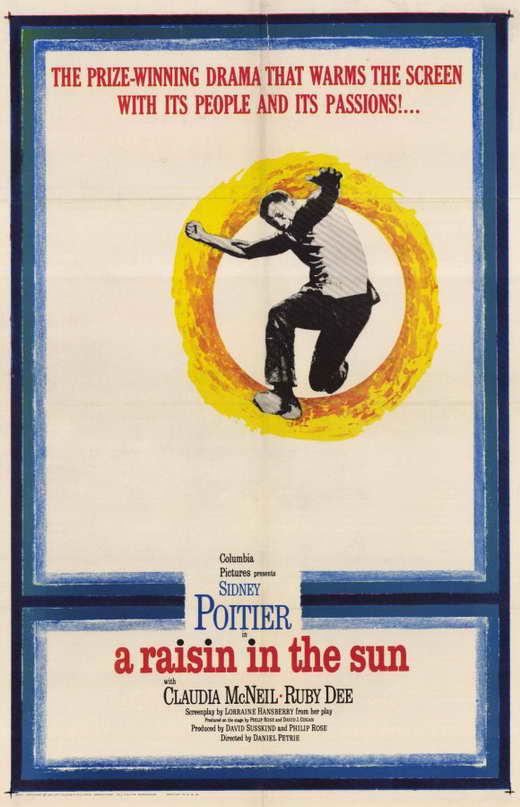
BOOK VS MOVIE: A Raisin in the Sun

I've read a number of plays in recent years, but I realized that there aren't many female playwrights. One I've come across is Lorraine Hansberry.

She is the author of A Raisin in the Sun, a play I call a favorite. It chronicles the life of the poverty-stricken Younger family. Each family member had dreams, but they require money. An insurance check comes in the mail. Will their dreams come true?

I admire A Raisin in the Sun for its dialogue. It's honest and believable, as though snatches of it were taken from Hansberry's own life.

The movie remains true to the original play, apart from a few minimal changes here and there. The two performances that stood out the most for me were from Sidney Poitier and Ruby Dee, basically because they were the most down to earth.

All in all, I really liked both versions of A Raisin in the Sun. It's hard for me to choose which one I like best.

What's worth checking out?: I'd go with both.

Tuesday, March 29, 2011

Waiting for Lefty

By now, you should know that I have an admiration for plays. I prefer plays with dialogue that stands out. Clifford Odets' Waiting for Lefty has just that.

Odets was responsible for co-writing one of my all-time favorite movies. After hearing the snappy yet vile dialogue in that, I grew curious in Odets' other works outside of Hollywood.

Waiting for Lefty revolves around cab drivers planning a strike. This was written when strikes were becoming commonplace for New York City. Do I have a problem with that? Not at all.

The only thing I didn't like about Waiting for Lefty was that each act would flip flop between characters that had no real connection. It got a bit confusing. But still, I loved Odets' way of words.

My Rating: ****

Tuesday, March 1, 2011

BOOK VS MOVIE: Suddenly, Last Summer

I've noticed from the adaptations of Tennessee Williams' plays that they are star-studded. From the ones I've seen (A Streetcar Named Desire, The Night of the Iguana, Cat on a Hot Tin Roof, Suddenly, Last Summer), that claim is true.

In the adaptation of Suddenly, Last Summer, it stars Elizabeth Taylor, Montgomery Clift and Katharine Hepburn. They act their roles well, but I thought that Hepburn was a little out of place.

The story of Suddenly, Last Summer is about Dr. Cuckrowicz being called upon by Violet Venable to perform a lobotomy on her niece Catherine Holly. Catherine knows disturbing details about the death of her cousin Sebastian, Violet's son. Cuckrowicz wants to know more about the scenario from Catherine before making his final decision.

There's a bit of an autobiographical feel to Suddenly, Last Summer. Williams had a sister who underwent a lobotomy by the urging of their parents. The lobotomy allegedly contributed to Williams' alcoholism and drug addiction. Another example of art imitating life.

Though it's not one of Williams' best, Suddenly, Last Summer is a very good play. The movie could've been improved as well, but again it was good.

What's worth checking out?: I'd go with the play.

Tuesday, February 1, 2011

BOOK VS MOVIE: Glengarry Glen Ross

I have read works by classic playwrights (Tennessee Williams, Arthur Miller, Eugene O'Neill) as well as a work by a modern playwright. That modern playwright is David Mamet; the play is Glengarry Glen Ross.

Mamet has to be one of the more...explicit playwrights I have read. Explicit as in his characters speak their minds more than once and explicit as in his characters drop the f-bomb more than once.

Glengarry Glen Ross in some ways is a modern take of Death of a Salesman. The character in Glengarry Glen Ross that represents Death of a Salesman's Willy Loman best is Shelley Levene, who in the movie is played by Jack Lemmon in his best work. Like Loman, Levene was once a big shot who now struggles to scrape by. It's a complex role that only a great actor can play and Lemmon nails it.

Along with Lemmon, the cast for Glengarry Glen Ross includes Al Pacino, Kevin Spacey, Ed Harris, Alan Arkin and Alec Baldwin, the latter has the most epic scene (Mamet wrote it for the movie). It's an ideally chosen and well-acted cast. Could there be a more perfect one?

What's worth checking out?: I'd go with both.

Saturday, January 1, 2011

BOOK VS MOVIE: Cat on a Hot Tin Roof

I have read five plays written by Tennessee Williams: A Streetcar Named Desire, The Glass Menagerie, Cat on a Hot Tin Roof, Orpheus Descending and Suddenly, Last Summer.

Brick Pollitt is a former football player who drinks his days away. His wife Maggie has all but failed to entice him. His father Big Daddy, dying of cancer, wants to give his plantation to Brick and Maggie, much to the dismay of Brick's brother and his wife.

Williams' play is a fine drama with excellent characters that always have you interested about them. Richard Brooks' film is well-acted and Paul Newman, Elizabeth Taylor and Burl Ives are perfectly cast in their roles. Cat on a Hot Tin Roof is one of those rare examples where the book and its film adaptation are both very well done, making it almost impossible to say which one is better.

What's worth checking out?: I'd go with both.

Sunday, October 17, 2010

Death of a Salesman

When the name of Arthur Miller is mentioned, two of his plays are thought of. Those plays are The Crucible and Death of a Salesman, the latter I'll be reviewing.

Death of a Salesman focuses on aging salesman Willy Loman. He has become distant from his family and he escapes to memories of his past.

The dialogue throughout Death of a Salesman is very natural, fitting the American lifestyle. The most pivotal scene in the play is one of the best I've read. Willy is one of the more believable fictional characters that has been created. Death of a Salesman gives a view of American society slowly crumbling under tension.

My Rating: ****1/2

Saturday, October 16, 2010

The Iceman Cometh

Common themes in works by Eugene O'Neill are melancholia, alcoholism and death. Cheerful guy, isn't he?

The patrons of Harry Hope's bar anticipate the annual arrival of Hickey. But this year, Hickey tries to liven up the pipe-dreaming drunks which causes tensions to flare.

Damn, O'Neill, you're really a pessimistic person, aren't you? My point is also proven in Long Day's Journey into Night. I found the scenes between Parritt and Larry contain some of the most emotional dialogue I've read. Hickey teeters on the line of insulting and friendly. His statements are derogatory, but he saves his dignity and pride with his charming comments. This is the best O'Neill play I've read.

My Rating: ****1/2

Thursday, July 15, 2010

All My Sons

Along with Tennessee Willaims, I admire the plays of Arthur Miller. Having read three of his best-known works (The Crucible, Death of a Salesman, All My Sons), I know that he's a rather good playwright.

Joe Keller had manufactured defective airplane parts during the war, which resulted in the deaths of twenty-one men. His business partner Herbert Deever was blamed for the faulty parts and was sent to jail. Herbert's son George returns home from the war and his reaction to what has happened is stunning.

I'm starting to think that Miller had some father issues because the strained realtionship between father and son is evident in this (as well as Death of a Salesman). The dialogue is powerful and affecting, while the characters are fully developed.

My Rating: ****