Sunday, January 2, 2022

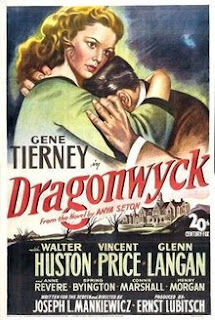
Dragonwyck

There's no denying that Joseph L. Mankiewicz boasted quite the illustrious career in Hollywood. Be it as a writer, producer, or director, he and brother Herman had stories to tell and succeeded in their endeavors. It's little wonder that the name "Mankiewicz" still means something in that town.

By the time Mankiewicz made his directing debut with Dragonwyck, he had been well-established for several years. (He got the gig because original director Ernst Lubitsch fell ill.) And boy, you'd never know this was his first time directing as you watch it. (Granted, he also co-wrote the script so already he had an idea of how the film flowed.)

Bearing elements reminiscent of Rebecca six years earlier, Dragonwyck is the kind of film that Hollywood -- barring Crimson Peak, perhaps -- doesn't make anymore. And that's a shame, really; it's a genre that has a little bit of everything (with more focus on some elements than others) and it's a solid deviation of the standard romance. (Because -- let's be honest -- romance itself is more complex than what Hollywood has us believe.)

Having more screentime together here than in their previous collaborations (Laura and Leave Her to Heaven), Gene Tierney and Vincent Price have excellent chemistry together. And Price -- after years of bit parts and supporting roles -- finally has a meaty role to sink his teeth into. (It was originally going to be Gregory Peck but he dropped out after Lubitsch did.) Makes you wonder had he gotten more roles like this throughout his career.

Dragonwyck is one of those few directorial debuts that works after all these years. With stunning cinematography by Arthur C. Miller and a chilling score from Arthur Newman, it just proves that Hollywood has been playing it safe for too long. Take more risks, Hollywood, like you did before the MPAA came to fruition.

My Rating: ****1/2

Friday, December 31, 2021

Film and Book Tally 2021

Well, this year of viewings and readings was slowed down a bit by me wanting to focus more on fiction writing (as well as helping out around the house). Still, I manage to squeeze some time in for these. Anyway, you know the drill. (Heads up: it's not an impressive list.)

Thursday, December 31, 2020

Film And Book Tally 2020

Well, this year started off promising...and then coronavirus happened. But I try to stay positive in light of such situations; for instance, I got some reading in because of the quarantine but even then, it fell short of my goal. Still, take what you get, y'know? Anyway, my year-end list (a bit shorter than I would like) starts after the jump:

Monday, September 28, 2020

City Streets

Nan Cooley (Sylvia Sidney) of Rouben Mamoulian's City Streets leads a charmed life. Her racketeer father ensures a comfortable life for her and she gets involved with circus sharpshooter The Kid (Gary Cooper). But then she gets sent to jail for being an accessory to murder, and Nan wants nothing to do with the criminal life...which is a problem because The Kid has since gotten into the business.

In contrast to Mamoulian's more lavish productions like Queen Christina and Blood and Sand, City Streets is more bare-bones to the director's other works. That's not to disregard it, far from it. If anything, we get to see glimpses of what would become fixtures in his later career.

Similar to what Mamoulian would do with Dr. Jekyll and Mr. Hyde, he depicts the duality of both Nan and The Kid's personalities in the life of crime. She seems fine with a sense of normalcy after her prison stint whereas he fully embraces the thrill of criminal behavior after first balking it. But what will this shift in attitudes mean for the couple?

Also on display in City Streets is a sort of misogyny that becomes more prevalent in later films in the genre. A moll becomes blind with jealousy as her man blatantly makes passes at Nan (who isn't interested) but her anger is directed solely at the other woman. Frustratingly, she's the only other female character of note in the film. Still, better than Nan being the token woman in a male-dominated film.

City Streets is surprisingly seedier than other genre titles of the era. In comparison to those starring James Cagney, there's an obvious emptiness in the opulence on display. (Material goods to make up for emotional vacancy?) And Mamoulian would feature that in later works too.

My Rating: ****1/2

Saturday, September 26, 2020

Love Letters

The tone of William Dieterle's Love Letters is established in its first scene as Alan Quinton (Joseph Cotten) writes a letter for his friend Roger Morland (Robert Sully). Alan loathes the idea of writing love letters to a girl neither man has met, feeling that she'll fall in love with the letters than the actual man. It's particularly jarring since the film is written by Ayn Rand. (Yes, you read that right.)

If that sounds familiar, that's because it should. Rand had deviated from the source novel in favor of making Love Letters more of a modern-day telling of Cyrano de Bergerac. But in stark contrast to the events of Edmond Rostand's play, the aftermath of Alan writing in Roger's name has far dire consequences than anyone could've imagined that's darker than what usually came out of Hollywood at the time.

Similar to Portrait of Jennie -- the next collaboration between Dieterle, Cotten, and Jennifer Jones -- it has Jones' character having an otherworldly nature to her. Her Singleton has no memory of her past, only faint glimmers of what has transpired. It's when we learn of her history that we learn how dark her past is.

But in contrast to Portrait of Jennie, Love Letters is decidedly more cynical in nature. Being a survivor of war, Alan is just tired of what the world is capable of inflicting. It's when he meets Singleton that he finds a light in this dark time in his life.

Love Letters is more pessimistic than other romance titles of the era but at the same time, it's somehow more realistic. Love is far from being a panacea (as Hollywood likes to claim) but with enough compassion and empathy towards the right person, the weight of some of your problems lightens. (Still seek out proper treatment regardless.)

My Rating: ****1/2

Raw Deal

The narration from Pat Regan (Claire Trevor) in Anthony Mann's Raw Deal shows an undying loyalty to Joe Sullivan (Dennis O'Keefe) as she helps him escape from prison. But when his caseworker Ann Martin (Marsha Hunt) becomes a begrudging accomplice (they need another getaway car), it then drips with jealousy as Pat fears the presence of the other woman.

If anything, Raw Deal is less about a criminal on the run as it is about the people they've encountered. Be it the women that love him or the men that betrayed him, the film shows how those that encounter Joe invariably have their lives changed. And more often than not, it isn't for the better.

Along with westerns, film noir was the genre where Mann thrived. As he would do with Side Street soon after, he shows a keen eye towards the darkness within humanity. Some become resigned to the fact that illegal activity is how they'll survive in the world while others fully embrace this new life.

And boy, does Raw Deal live up to its title. Its morality is a murky gray at best, neither black nor white. John Alton's cinematography exemplifies this atmosphere, the shadows playing as much of a role as the actors. (The fact that Alton was recognized only once by AMPAS -- though thankfully won -- is something of an insult when it comes to cinematography.)

Raw Deal marked a decided change in how Hollywood told stories. Titles in the years to come had a streak of danger to them, their way of seeing how far they can push the envelope. And Mann was the one who instigated this shift. (Just look at the westerns he made with James Stewart a few years later.)

My Rating: ****1/2

Friday, September 25, 2020

The Mortal Storm

Frank Borzage's The Mortal Storm begins innocuously enough. The family and students of professor Viktor Roth (Frank Morgan) celebrate his birthday. During a small gathering that evening, his student Fritz Marberg (Robert Young) announces his engagement to Viktor's daughter Freya (Magaret Sullavan). And Adolf Hitler is sworn in as chancellor of Germany.

Like a switch, the tone of The Mortal Storm gets darker. The respect for Professor Roth turns into contempt as his peers and students fully embrace Germany's new rule. Freya breaks off her engagement to Fritz, preferring the company of family friend Martin Breitner (James Stewart). And the small town they reside in begins to strain amid political tensions.

To no surprise, The Mortal Storm resulted in MGM's entire library being banned in Germany despite the studio making it vague about where the film is actually set. That being said, it was certainly daring to tackle the political atmosphere of the time. You certainly don't see anyone do something that daring nowadays.

In contrast to his earlier film Three Comrades, Borzage keeps the political message of the source novel in The Mortal Storm. Again, to make this during that time period was brazen to say the least. As Casablanca would do three years later, it effectively showed that Nazis were (and frustratingly still are) nothing more than fearmongering bullies.

The Mortal Storm is unnerving to watch eighty years later knowing that such attitudes still exist in some people. To judge someone on aspects they have no say in (i.e., race, gender, heritage) is far from the best way for society to run. What would future generations think of such backward thinking?

My Rating: ****

My Name Is Julia Ross

The titular character (Nina Foch) of Joseph H. Lewis' My Name Is Julia Ross starts the film searching for a job in London. She finds a plumb offering from an agency's newspaper ad and she's accepted on the spot. The next thing she knows, two days have passed and she's on a seaside estate in Cornwall...and she's being addressed as Marion Hughes.

Almost instantly My Name Is Julia Ross grabs the viewer by the throat and doesn't let go for its 64-minute runtime. Why is Julia being subjected to this kind of psychological warfare? Who are the people that so eagerly hired her? And what do they have planned for her?

Often lost in the shadow of Lewis' more famous title Gun Crazy, My Name Is Julia Ross established his role in the noir genre. He grasped the darkness lurking within humanity with both hands, showing how one can wear a mask for the world. But sometimes it doesn't take much for that mask to slip.

Mostly a forgotten name nowadays (most would recognize her as Gene Kelly's sponsor in An American in Paris), Foch shines in My Name Is Julia Ross. She captures the character's determination in finding out the truth as to why she's in this mental prison. And as soon as she's introduced, you're immediately rooting for her.

My Name Is Julia Ross is one of those titles that stays in your mind long after it's over. In its short duration, you get well-fleshed characters, a gripping plot, and one hell of a finale. This is one of those noir titles that is an imperative one to seek out.

My Rating: *****

Merrily We Go to Hell

When heiress Joan Prentice (Sylvia Sidney) first meets reporter Jerry Corbett (Fredric March) at the start of Dorothy Arzner's Merrily We Go to Hell, she's instantly smitten. They soon get engaged but Joan finds out that Jerry has a drinking problem. Through thick and thin, she stays loyal to him but how far will her devotion go?

Its title makes Merrily We Go to Hell sound like it'll be one of the scandalous pre-Codes of the era. In reality, however, it's more of how codependency isn't the foundation of a strong marriage (Joan bases her role as Jerry's wife on his happiness and little else). And that's not even getting into Jerry's relationship woes before (and since) marrying Joan.

Of course, being a pre-Code, the film neither condones nor condemns Jerry's actions but rather acknowledges that he could stand to change his ways a bit. Joan herself also gets this treatment when she starts to emulate Jerry but -- due to her health -- this phase of hedonism is short-lived. Sometimes a destructive lifestyle harms more than the person imbibing it.

As she would also show with Dance, Girl, Dance, Arzner shows how life can be unfair for women, some begrudgingly making sacrifices to achieve their dreams. In contrast to what Judy O'Brien went through in the later title, what Joan endures is far more demeaning. To watch your husband being flaunted by his lover and have to behave like it doesn't bother you...it doesn't get much crueler than that.

Merrily We Go to Hell is just proof that Arzner should be held in the same regard as her male contemporaries. (Just because she's a woman doesn't lessen her worth.) Her work was rediscovered shortly before her death in 1979; it's high time it gets another one.

My Rating: *****

What Price Hollywood?

We've all seen the standard trope: girl hopes to be a big name, gets a lucky break, and then is confronted with the pitfalls of fame soon after. The more famous example of this is found in A Star is Born with four versions being made over the years. But five years before the Fredric March and Janet Gaynor version, the one that started it all was released.

George Cukor's What Price Hollywood? has Brown Derby waitress Mary Evans (Constance Bennett) making a beeline for director Maximillan Carey (Lowell Sherman) when he stumbles into the restaurant one night. With some determination, she becomes a star but he slips deeper into alcoholism. What fates await them?

In contrast to Cukor's take on A Star is Born, What Price Hollywood? -- as its title implies -- has a far more suffocating depiction of stardom than the more famous title. (Being a pre-Code also adds to it.) Tabloids and newspapers serve as the film's segues for the characters' conflicts, how the public eye pries into their private lives. That can inflict more damage than anything else, especially if you're someone of note.

There's also a meta-humor with What Price Hollywood? in casting Sherman and Gregory Ratoff -- both directors in their own right -- as figures in movie production. Likewise, Bennett (whose sister Joan had a longer career herself) had her career become less in-demand by the 1940s. Ah, life imitating art imitating life.

What Price Hollywood? still has bite all these years later, perhaps not a surprise seeing as it's a Cukor title. If anything, it downplays what actresses endured in Hollywood then as Judy Garland was sad testament to. (Cukor meanwhile lapped up the Hollywood lifestyle.) And how strange how very little has changed since then...

My Rating: *****