You ever been in a low mood and your first solution is to watch a movie? It has and always will be the best way to forget your problems.
This is the case with Cecilia (Mia Farrow). She has good reason for her moviegoing. She's stuck in an abusive, loveless marriage, she has been fired from her job, and she's looking for an escape from the poverty throughout her neighborhood in Depression-era New Jersey. What better escape than going to the movies?
I've always liked Woody Allen's work (mainly Manhattan and Hannah and Her Sisters), mostly because he knows how to capture the movie's mood. With The Purple Rose of Cairo, he blends the feel of the 1930's with the ambiance of a comedy from that time. Not many movies can do that successfully.
I absolutely love The Purple Rose of Cairo. Farrow and Jeff Daniels have magnificent chemistry together. In fact, the movie acts as though it's from the 1930's. The ending just about crushed my heart, but that didn't stop me from adoring this movie.
My Rating: *****
Monday, November 21, 2011
Sunday, November 20, 2011
Beginners
A common theme in some independent movies is sadness. Usually it's because the main character(s) lost a loved one, ended a relationship or it's just within their nature.
In Beginners, we're already told of what has happened with Oliver (Ewan McGregor) within the first few minutes. Shortly after his mother passed away, his father Hal (Christopher Plummer) comes out and embraces the gay lifestyle before he dies. Oliver accepts what Hal has told him, but there's that look of uncertainty on his face.
As he tells his new girlfriend Anna (Melanie Laurent) about his father, you can pick up on the touch of sadness in Oliver's voice and eyes. He's clearly upset over his father's passing, however he's starting to embrace life without Hal. It's a tough task, but he has to do it sooner or later.
I really liked Beginners, mainly for the work from McGregor and Plummer. The simple addition of flashbacks is a nice touch. The low lighting also gives us a glimpse of what's inside Oliver's mind. The thing is though is that the movie is stuck in the same mood for the whole duration. That small flaw aside, Beginners is worth checking out.
My Rating: ****1/2
In Beginners, we're already told of what has happened with Oliver (Ewan McGregor) within the first few minutes. Shortly after his mother passed away, his father Hal (Christopher Plummer) comes out and embraces the gay lifestyle before he dies. Oliver accepts what Hal has told him, but there's that look of uncertainty on his face.
As he tells his new girlfriend Anna (Melanie Laurent) about his father, you can pick up on the touch of sadness in Oliver's voice and eyes. He's clearly upset over his father's passing, however he's starting to embrace life without Hal. It's a tough task, but he has to do it sooner or later.
I really liked Beginners, mainly for the work from McGregor and Plummer. The simple addition of flashbacks is a nice touch. The low lighting also gives us a glimpse of what's inside Oliver's mind. The thing is though is that the movie is stuck in the same mood for the whole duration. That small flaw aside, Beginners is worth checking out.
My Rating: ****1/2
Saturday, November 19, 2011
Winter's Bone
As for usual Hollywood standards, most female roles tend to cross into degrading territory. That's mostly for studio movies, mind you. At least independent movies are more focused on character examination rather than making money.
Debra Granik's Winter's Bone does have character examination, mainly in the roles by Jennifer Lawrence and John Hawkes (fittingly the two Oscar nominees). Lawrence may be the principle character, but I feel that Winter's Bone loses something when Hawkes isn't on screen.
Winter's Bone is also successful at depicting the rugged life some people have to face. Some will do anything to save or earn money, but they stop at desperate measures. The bleak weather and lack of light adds to the moody nature of the movie.
If you think this would be a positive review, think again. The narrative for this was so dense, I was certain I was going to fall asleep. The only things keeping the movie afloat are Lawrence and Hawkes. Everything else is weak.
My Rating: ***1/2
Debra Granik's Winter's Bone does have character examination, mainly in the roles by Jennifer Lawrence and John Hawkes (fittingly the two Oscar nominees). Lawrence may be the principle character, but I feel that Winter's Bone loses something when Hawkes isn't on screen.
Winter's Bone is also successful at depicting the rugged life some people have to face. Some will do anything to save or earn money, but they stop at desperate measures. The bleak weather and lack of light adds to the moody nature of the movie.
If you think this would be a positive review, think again. The narrative for this was so dense, I was certain I was going to fall asleep. The only things keeping the movie afloat are Lawrence and Hawkes. Everything else is weak.
My Rating: ***1/2
Friday, November 18, 2011
The Big Heat
Although I've only seen M and The Big Heat, I know enough that Fritz Lang had a certain style of directing. He had his movies burn slowly to excitement and a hell of an ending.
Glenn Ford is someone I've encountered before in Gilda and Blackboard Jungle. In both, he barely has enough of a spine to stand up for himself. In The Big Heat, he looks as though he's about to rip out someone's spine. Nice to see a man get tough every now and again.
Gloria Grahame was the quintessential femme fatale back in the day. However in The Big Heat, she does somewhat of a variation of the role. Her Debby Marsh doesn't want to harm Ford's Dave Bannion but rather help him with the cases that are slowly consuming him. The only people she wants to harm are those who harmed her. (That pot of coffee to the face had to hurt.)
The Big Heat gets up there as one of the best noirs I've seen. Ford and Grahame deliver their best work in this. Lang also manages to deliver the goods. A must for noir admirers.
My Rating: *****
Glenn Ford is someone I've encountered before in Gilda and Blackboard Jungle. In both, he barely has enough of a spine to stand up for himself. In The Big Heat, he looks as though he's about to rip out someone's spine. Nice to see a man get tough every now and again.
Gloria Grahame was the quintessential femme fatale back in the day. However in The Big Heat, she does somewhat of a variation of the role. Her Debby Marsh doesn't want to harm Ford's Dave Bannion but rather help him with the cases that are slowly consuming him. The only people she wants to harm are those who harmed her. (That pot of coffee to the face had to hurt.)
The Big Heat gets up there as one of the best noirs I've seen. Ford and Grahame deliver their best work in this. Lang also manages to deliver the goods. A must for noir admirers.
My Rating: *****
Thursday, November 17, 2011
Wild River
It's really sad that after his near-fatal car crash, studios were more than hesitant to cast Montgomery Clift in their projects. It wasn't just because his good looks were destroyed, but his mental state was as well.
Elia Kazan trusted Clift enough to cast him in Wild River. After all, Kazan had previously worked with Method acting pioneers Marlon Brando and James Dean, but Clift was different both acting-wise and mentally. Clift had a slow simmering type of acting, which he showcases in Wild River.
Wild River also stars Lee Remick, whom I also like. She is someone who I dub an "underactor" meaning her performances are so subtle and nuanced, they feel more like she's being herself rather than acting. Her work in Wild River is such an example.
Although the title implies otherwise, Wild River gets on the slow side more than once. It's a good movie, but I wouldn't generally rank it among On the Waterfront, A Streetcar Named Desire or A Face in the Crowd. I will say, however, that Clift and Remick some fine work.
My Rating: ****
Elia Kazan trusted Clift enough to cast him in Wild River. After all, Kazan had previously worked with Method acting pioneers Marlon Brando and James Dean, but Clift was different both acting-wise and mentally. Clift had a slow simmering type of acting, which he showcases in Wild River.
Wild River also stars Lee Remick, whom I also like. She is someone who I dub an "underactor" meaning her performances are so subtle and nuanced, they feel more like she's being herself rather than acting. Her work in Wild River is such an example.
Although the title implies otherwise, Wild River gets on the slow side more than once. It's a good movie, but I wouldn't generally rank it among On the Waterfront, A Streetcar Named Desire or A Face in the Crowd. I will say, however, that Clift and Remick some fine work.
My Rating: ****
Wednesday, November 16, 2011
Imitation of Life
With some directors, I usually associate them with the things and/or themes in their movies (ie, Fellini's religious imagery, Tarantino's cuss-filled dialogue, Hitchcock's mysterious blondes, Hawks' fast-talking women, etc.). It can lead to problems however.
Take Douglas Sirk for example. In the way critics and film lovers describe him, Sirk is viewed as making overly dramatic "women's pictures". After seeing Magnificent Obsession, I went with that for some time. When I saw Imitation of Life, that stereotype of Sirk was thrown out the window.
The main characters of Imitation of Life are two mothers and two daughters. Lora Meredith (Lana Turner) is a stage actress who tries to be a good mother to Susie (Sandra Dee), but her career constantly interferes with her family life. Lora's maid Annie Johnson (Juanita Moore) tries to regain the love of her daughter Sarah Jane (Susan Kohner), but it's impossible because Sarah Jane refuses to accept that she has mixed blood. Turner and Dee are the bigger names, but it's Moore and Kohner that make Imitation of Life what it is.
Imitation of Life is a lot better than I originally thought, however I thought it was a little mushy in a few scenes. All in all, this was a fitting send-off for a director like Sirk.
My Rating: ****1/2
Take Douglas Sirk for example. In the way critics and film lovers describe him, Sirk is viewed as making overly dramatic "women's pictures". After seeing Magnificent Obsession, I went with that for some time. When I saw Imitation of Life, that stereotype of Sirk was thrown out the window.
The main characters of Imitation of Life are two mothers and two daughters. Lora Meredith (Lana Turner) is a stage actress who tries to be a good mother to Susie (Sandra Dee), but her career constantly interferes with her family life. Lora's maid Annie Johnson (Juanita Moore) tries to regain the love of her daughter Sarah Jane (Susan Kohner), but it's impossible because Sarah Jane refuses to accept that she has mixed blood. Turner and Dee are the bigger names, but it's Moore and Kohner that make Imitation of Life what it is.
Imitation of Life is a lot better than I originally thought, however I thought it was a little mushy in a few scenes. All in all, this was a fitting send-off for a director like Sirk.
My Rating: ****1/2
Tuesday, November 15, 2011
How to Marry a Millionaire
I usually like comedies from the classic era because the jokes were what the jokes in today's comedies are not: funny. Older comedies relied on jokes with wit rather than today's comedies relying on jokes with bad taste.
How to Marry a Millionaire I like because, as mentioned, the jokes are actually funny. They still work after nearly sixty years, so that's good. (I personally like when Lauren Bacall making reference to husband Humphrey Bogart as "that old fellow what's-his-name from The African Queen".)
I really liked the performances in How to Marry a Millionaire. Bacall possesses a New York attitude that has her in charge. Betty Grable, whom I'm not too familiar with, did manage to grasp my attention with her work. William Powell is his debonair self as the beau and eventual fiance of Bacall. (Who wouldn't want to marry him?) But my favorite performance came from Marilyn Monroe, whom I'm starting to like more with each passing movie. She showcases the typical ditzy blonde persona, but she gives a new take on it.
To sum things up, I really liked How to Marry a Millionaire. It gets a little silly in some scenes, but it's a very clever comedy. It also makes me long for a new comedy that mirrors the classics.
My Rating: ****1/2
How to Marry a Millionaire I like because, as mentioned, the jokes are actually funny. They still work after nearly sixty years, so that's good. (I personally like when Lauren Bacall making reference to husband Humphrey Bogart as "that old fellow what's-his-name from The African Queen".)
I really liked the performances in How to Marry a Millionaire. Bacall possesses a New York attitude that has her in charge. Betty Grable, whom I'm not too familiar with, did manage to grasp my attention with her work. William Powell is his debonair self as the beau and eventual fiance of Bacall. (Who wouldn't want to marry him?) But my favorite performance came from Marilyn Monroe, whom I'm starting to like more with each passing movie. She showcases the typical ditzy blonde persona, but she gives a new take on it.
To sum things up, I really liked How to Marry a Millionaire. It gets a little silly in some scenes, but it's a very clever comedy. It also makes me long for a new comedy that mirrors the classics.
My Rating: ****1/2
Monday, November 14, 2011
Out of the Past
As popular as film noir was back in the 1940's and 1950's, sometimes the more famous titles weren't as successful upon their release.
That wasn't the case with Jacques Tourneur's Out of the Past. It was heralded as one of the greatest noirs ever made, and upon seeing it I can understand why. It has many common elements of noir that flow with immense ease.
Jeff Bailey best captures Robert Mitchum's screen persona of the laid back anti-hero. He's willing to find Kathie Moffat (Jane Greer) for Whit Sterling (the first glimpse of Kirk Douglas' devious screen persona) but upon seeing her, Jeff has almost met his match.
My opinion on Out of the Past is a bit different than perhaps that of others. I thought it was quite good, and I particularly liked the work from Mitchum and Douglas. However, I thought the narrative was a little jumbled. I still think it's good though.
My Rating: ****1/2
That wasn't the case with Jacques Tourneur's Out of the Past. It was heralded as one of the greatest noirs ever made, and upon seeing it I can understand why. It has many common elements of noir that flow with immense ease.
Jeff Bailey best captures Robert Mitchum's screen persona of the laid back anti-hero. He's willing to find Kathie Moffat (Jane Greer) for Whit Sterling (the first glimpse of Kirk Douglas' devious screen persona) but upon seeing her, Jeff has almost met his match.
My opinion on Out of the Past is a bit different than perhaps that of others. I thought it was quite good, and I particularly liked the work from Mitchum and Douglas. However, I thought the narrative was a little jumbled. I still think it's good though.
My Rating: ****1/2
Sunday, November 13, 2011
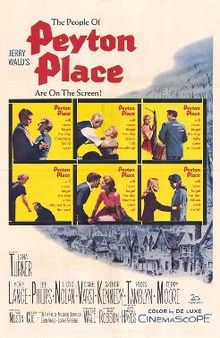
Peyton Place
During the 1950's, the melodrama was a popular genre among female audiences. The more popular ones were made by Douglas Sirk, but some were made by others.
Peyton Place by today's standards contains every personal tragedy in the book (rape, suicide, abortion, illegitimacy). After all, these were subjects that were "hush hush" in mixed company back then. But thanks to Mark Robson, he makes this less Douglas Sirk and more dignified soap opera.
Of course like most soap operas, the pinnacle of Peyton Place has to be the actors. The best work came from the actors who were nominated for Oscars: Lana Turner, Diane Varsi, Hope Lange, Arthur Kennedy and Russ Tamblyn. I found it amusing that Turner, a victim of many scandals, was cast where her character has a secret that would destroy her reputation.
All in all, I really liked Peyton Place. The time might be a shock to some (over two and a half hours), but surprisingly the times flies right by though it drags a little in the third act. Again, I just love the performances. This is for those who want a non-Sirk melodrama.
My Rating: ****1/2
Peyton Place by today's standards contains every personal tragedy in the book (rape, suicide, abortion, illegitimacy). After all, these were subjects that were "hush hush" in mixed company back then. But thanks to Mark Robson, he makes this less Douglas Sirk and more dignified soap opera.
Of course like most soap operas, the pinnacle of Peyton Place has to be the actors. The best work came from the actors who were nominated for Oscars: Lana Turner, Diane Varsi, Hope Lange, Arthur Kennedy and Russ Tamblyn. I found it amusing that Turner, a victim of many scandals, was cast where her character has a secret that would destroy her reputation.
All in all, I really liked Peyton Place. The time might be a shock to some (over two and a half hours), but surprisingly the times flies right by though it drags a little in the third act. Again, I just love the performances. This is for those who want a non-Sirk melodrama.
My Rating: ****1/2
Saturday, November 12, 2011
The Postman Always Rings Twice
There have been many famous femme fatales in movies. Some of the more notable ones include Barbara Stanwyck in Double Indemnity, Rita Hayworth in Gilda and Ava Gardner in The Killers. They were proven to be poisonous to Fred MacMurray, Glenn Ford and Burt Lancaster in their respective movies.
Another on is Lana Turner's Cora Smith in The Postman Always Rings Twice. She wears nothing but white throughout (she wears black in one scene where she contemplates suicide), however she doesn't become a true femme fatale until the lovesick Frank Chambers (John Garfield) suggests to get rid of her husband Nick (Cecil Kellaway).
It's hard to distinguish who is the root of all evil, Cora or Frank. On the one hand, it's Frank who suggests murder. But once Nick is done away with, Cora becomes more defensive about her behavior, almost to the brink of getting of anyone who gets too close or knows too much.
The Postman Always Rings Twice is very good, but there are some moments that could have been improved or kept out all together. Doesn't mean I didn't like it though.
My Rating: ****1/2
Another on is Lana Turner's Cora Smith in The Postman Always Rings Twice. She wears nothing but white throughout (she wears black in one scene where she contemplates suicide), however she doesn't become a true femme fatale until the lovesick Frank Chambers (John Garfield) suggests to get rid of her husband Nick (Cecil Kellaway).
It's hard to distinguish who is the root of all evil, Cora or Frank. On the one hand, it's Frank who suggests murder. But once Nick is done away with, Cora becomes more defensive about her behavior, almost to the brink of getting of anyone who gets too close or knows too much.
The Postman Always Rings Twice is very good, but there are some moments that could have been improved or kept out all together. Doesn't mean I didn't like it though.
My Rating: ****1/2
Subscribe to:
Posts (Atom)