Showing posts with label director: Hal Ashby. Show all posts

Wednesday, October 25, 2017

The Last Detail

With the arrival of New Hollywood generation, a sense of cynicism became prevalent in the works from this time. It makes sense actually; with a senseless war raging on, the economy wasn't generally in the best of shape, and politics being like-minded with other events, it's no wonder such attitudes were channeled.

And Hal Ashby's The Last Detail particularly captures such a sensation. Being a post-Watergate release, it shows a disillusionment towards various establishments. And this was when baby boomers were beginning to rebel the previous generation's ideals so this just seemed like good timing for it.

Like what he did with Coming Home five years later, Ashby depicts an America just trying to carry on in life despite what's happening around them. They eat, they sleep, they have sex...just the general basics some people have and do on a regular basis. (It may not be much but it's how some stay connected to the world.)

Being made just a few years after Robert Altman found success with M*A*S*H, it's possible Ashby wanted to repeat those results with The Last Detail. After all, both are dark comedies with an ongoing war as its backdrop so it's not too much of a stretch. (The difference, of course, being which war was ensuing and where the military men were situated.)

Anyway, The Last Detail serves as a sort of timepiece for the era it hails from. This was a time where one's guard was generally lowered on a daily basis, again perhaps because of the collective embitterment from everyday life. And that's what stands out the most nearly forty-five years later: how the small joys in life aren't enough to combat reality.

My Rating: ****

Sunday, April 1, 2012

BOOK VS MOVIE: Being There

Jerzy Kosinski's novel and Hal Ashby's film Being There both depict society as obsessed with the media. They must know everything about someone or something, so much so the thought process gets all mixed up.

The only person unaffected by this is Chance. Sure, he watches a fair amount of television, but it doesn't particularly stick. When he speaks, everyone assumes there is a philosophical meaning behind his words. Is there? No, he merely says what little information he has learned in his life.

Kosinski's novel is written in the third person, but it's evident that it's told from Chance's perspective. The writing style is simplistic and doesn't go into grand detail about anything. Not that it's a bad thing at all. It allows the reader to see the world through Chance's eyes.

Ashby's film possesses the same subtle tone that Kosinski's novel has, yet at the same time it feels more sincere than the novel. That's because Peter Sellers' role of Chance makes it possible. Far from the manic roles he did in the years before, Sellers displays a sort of silent honesty in Chance. His Oscar loss will remain a blight on the Academy.

Both the novel and the film have their own charms, though it's the film that proves victorious. It has a truthfulness that the novel (and most other films) lacks. It also captures how dependent society has become towards the media, which is still painfully relevant today.

What's worth checking out?: I'd go with the movie.

Tuesday, December 21, 2010

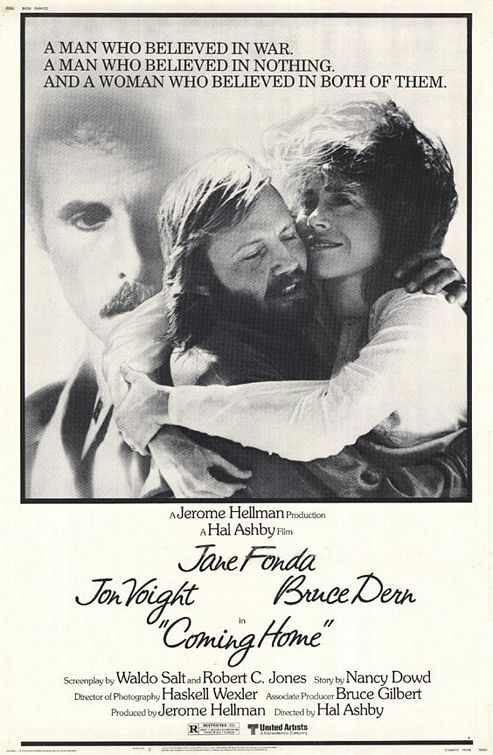
Coming Home

1978 had to be an interesting year for movies. I mean, you had a movie that was pro-Vietnam (The Deer Hunter) and another that was anti-Vietnam (Coming Home), both of which competed for Oscars. Both were victorious.

While her husband Bob (Bruce Dern) is serving in Vietnam, Sally Hyde (Jane Fonda) decides to volunteer at the local VA hospital. There, she meets paraplegic veteran Luke Martin (Jon Voight), with whom she has an affair with.

The work from Fonda, Voight and Dern is very good, so it's clear to see why they were nominated (with Fonda and Voight winning). Coming Home, much like The Deer Hunter, focuses on the effects of war on returning soldiers. But The Deer Hunter shows how far those effects will push a person to the edge; Coming Home only shows the minimal effects a soldier endures. But Hal Ashby (who's better known for the cult classic Harold and Maude) manages to provide a sensitive view on returning soldiers of the Vietnam War.

My Rating: ****1/2