Showing posts with label director: Fritz Lang. Show all posts

Thursday, September 24, 2020

You and Me

The opening moments of Fritz Lang's You and Me shows the employees of a department store interacting with their customers. The behavior of some of them raises a few eyebrows. It turns out -- at the insistence of the store's owner -- the employees are parolees.

Two of the employees -- Joe Dennis (George Raft) and Helen Roberts (Sylvia Sidney) -- decide to get married and for a while, they seem happy. But Joe's criminal past is always close behind, and Helen isn't exactly forthright about her own past. What will happen to the newlyweds?

Now a premise like that makes You and Me sound like it's on par with Lang's noir titles like The Big Heat and The Blue Gardenia. In fact, there's a surprising levity to this that one may not associate with it with Lang's work. Thanks to Virginia Van Upp's script, it's a charming oddity in the director's oeuvre.

Lang himself wasn't proud of the finished product but that doesn't mean that it should be disregarded. You and Me was his third film with Sidney so he certainly knew what her strengths were by this point. Likewise, this was a subversion of the tough guy roles that made Raft famous. So all in all, it isn't as lackluster as Lang claims.

You and Me loses steam in its final third but Raft and Sidney keep it going nonetheless. In comparison to Lang's more famous titles, it's more of a breather amid his darker ones. So if you ever come across it in the near future, be sure to check it out.

My Rating: ***1/2

Tuesday, November 14, 2017

The Blue Gardenia

Several minutes into Fritz Lang's The Blue Gardenia, and we watch Norah Larkin (Anne Baxter) preparing a birthday dinner for herself. She had recently gotten a letter from her fiance from overseas (he's serving in the Korean War) so she's got a spring in her step. But her happiness is quickly deflated when the letter tells her he's leaving her for a nurse that treated him.

Devastated, Norah goes to drown her sorrows at the titular restaurant with womanizer Harry Prebble (Raymond Burr). The next morning, she wakes up to a splitting headache, the events of the previous night a complete blank. And then news breaks of Harry's murder...

Lang was having a good year in 1953. As well as The Blue Gardenia, he also had The Big Heat released. And as he previously showed with M and Scarlet Street, noir was where he excelled. (Perhaps deploying some tricks he learned before leaving his native Vienna?)

And while she's known as the conniving titular character of All About Eve, Baxter was more than capable of playing vulnerable women. (After all, she won an Oscar for doing such a role in The Razor's Edge.) Her Norah is constantly on pins and needles following that night, fearing that she might be the one responsible for Harry's death. But is she?

The Blue Gardenia further the belief that Lang is one of several names synonymous with film noir. With ominous lighting and shadows doing the same, Lang also captures a public that's morbidly drawn to bloodshed and the kind of press it can conjure up. (The man sure knew how to make a picture, huh?)

My Rating: ****1/2

Tuesday, November 3, 2015

Scarlet Street

It's clear early on in Fritz Lang's Scarlet Street that Edward G. Robinson is in a different type of role than his usual tough guy fare. His character of Christopher Cross is decidedly more sensible than the likes of Rico or Johnny Rocco. Then he crosses paths with Kitty March (Joan Bennett).

Despite being married (albeit unhappily), Cross becomes smitten with Kitty. Unbeknownst to him, Kitty already has a beau: low-life Johnny Prince (Dan Duryea). And it isn't long before Kitty starts playing Cross for all he's worth. (Rule of thumb for film noirs: never trust dames in tight dresses.)

Lang has contributed his fair share of films to the noir genre. (Other titles include M and The Big Heat.) So how does Scarlet Street compare to his more famous titles? Being a post-war noir, it explores more on the matters of sexual desire and moral ambiguity. It also shows how you shouldn't believe everything you're told.

And the performances from Robinson and Bennett are fantastic, providing a nice foil for each other. His meek to her brash, his feeble to her loud. (In fact, a later scene between them is reminiscent of a similar interaction from Of Human Bondage.) You see such foils frequently but seldom with the woman in the crasser role.

Scarlet Street is definitely one of the more underseen titles of both Lang's career and the film noir genre as a whole. Thanks to the work from Robinson and Bennett, it's the kind of film that's one hell of a character study. Also, the ending's one of the finer examples of cruel, cruel irony.

My Rating: *****

Friday, November 18, 2011

The Big Heat

Although I've only seen M and The Big Heat, I know enough that Fritz Lang had a certain style of directing. He had his movies burn slowly to excitement and a hell of an ending.

Glenn Ford is someone I've encountered before in Gilda and Blackboard Jungle. In both, he barely has enough of a spine to stand up for himself. In The Big Heat, he looks as though he's about to rip out someone's spine. Nice to see a man get tough every now and again.

Gloria Grahame was the quintessential femme fatale back in the day. However in The Big Heat, she does somewhat of a variation of the role. Her Debby Marsh doesn't want to harm Ford's Dave Bannion but rather help him with the cases that are slowly consuming him. The only people she wants to harm are those who harmed her. (That pot of coffee to the face had to hurt.)

The Big Heat gets up there as one of the best noirs I've seen. Ford and Grahame deliver their best work in this. Lang also manages to deliver the goods. A must for noir admirers.

My Rating: *****

Sunday, December 5, 2010

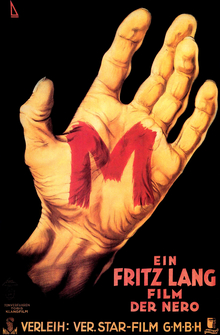
M

Fritz Lang is best known for two movies: the sci-fi classic Metropolis and the film noir M.

In a German city, a child murderer is on the loose. The crimes are so horrific, the local criminals are willing to find the culprit. But who's responsible for these crimes? That would be Hans Beckert (Peter Lorre).

Heavy stuff here. M is considered to be the very first serial killer movie, so it's clear that M had an influence on later movies of the sort. Lorre shows both a vulnerable yet horrifying nature of his character. The speech Lorre gives for why he has an impulse to kill has to be one of the more chilling speeches I've heard. If you can only watch one foreign movie in your life, make it M.

My Rating: *****