Showing posts with label 1950s. Show all posts

Tuesday, June 3, 2025

Trapeze

Carol Reed is one of the names most synonymous with the film noir genre. With other genres, there always seemed to be something amiss. Most of the time, it has to do with the picture being more about style than substance. Still, some of the tricks Reed learned from his noir pictures show up in these.

Take, for instance, Trapeze. Being one of his few films made in Hollywood, Reed has more of a scale to work on than Odd Man Out and The Third Man the previous decade. But as was commonplace for titles of the time, having more isn't always a good thing. It tries to put in too much with a two-hour runtime.

Starring in Trapeze are Burt Lancaster, Tony Curtis, and Gina Lollobrigida, all of whom as the film's living eye candy. Of them, Lollobrigida (and co-star Katy Jurado) has the more substantial role, acting as the classic femme fatale in some scenes. (Amusingly, Lancaster and Curtis' earlier interactions are similar -- albeit less cynical -- to what they'd do in Sweet Smell of Success the following year.)

Now Trapeze was shot in CinemaScope, and boy, does it show. The sweeping shots of the circus interiors courtesy of Robert Krasker proves that cinema can lead to something beautiful. The problem is that the general picture relies more on the images than the story that goes with them. Such is life.

Trapeze is by all accounts the standard spectacle picture of the 1950s but it still has its moments. A little bit more time spent on the script would've benefited it greatly. But all in all, it's the kind of film you can't see yourself watching again...unless you're in that kind of mood.

My Rating: ***1/2

Sunday, October 6, 2024

The Thing from Another World

For years, there has been speculation that Christian Nyby's The Thing from Another World wasn't directed by Nyby but rather by producer Howard Hawks. Yes, Hawks' fingerprints are all over the dialogue (he was an uncredited writer) but bear in mind that Nyby had edited several of Hawks' movies; it's more than likely it merely rubbed off on Nyby.

Obviously, The Thing from Another World is starkly different from John Carpenter's remake thirty-one years later. Whereas the latter sees trust (and the cast) getting torn to shreds, the earlier film is your standard '50s monster picture. That said, it's a good watch all the same.

In comparison to other sci-fi titles of the era, The Thing from Another World doesn't serve as a Cold War/Red Scare allegory. Again, it's a straightforward monster movie, simple as that. It may be a B picture but even those have their merits.

Speaking of which, the practical effects of The Thing from Another World are, well, out of this world. From the titular thing (played by a pre-Gunsmoke James Arness) to the various pyrotechnics, it's a display that B movies don't skimp on where it matters.

The Thing from Another World shows that a simple premise can go a long way. And while it doesn't measure up to Carpenter's take, it still showcases a daringness regularly seen at that time. (And yes, Nyby directed this, not Hawks.)

My Rating: ****

Wednesday, January 3, 2024

Gun Crazy

From the first moment Annie Laurie Starr (Peggy Cummins) laid eyes on Bart Tare (John Dall) in Joseph H. Lewis' Gun Crazy, their fates were sealed. Their first interaction crackled with an energy you can only find in a picture from after World War II. (With a script co-penned by a blacklisted Dalton Trumbo, can you go wrong?)

Acting like a post-war Bonnie and Clyde (Cummins even dresses like Faye Dunaway would the following decade), they commit robberies and live off their takes. But Bart knows this can't last forever so what will win out: his conscience or Laurie's insistence?

Dall nowadays is known for this and Rope, and it's interesting to see him play essentially both his and Farley Granger's roles from the earlier film in Gun Crazy. His Bart has Brandon's fascination for violence but also Phillip's nervous disposition towards it. To think there's only a two-year gap between the films.

But Cummins is the real draw of Gun Crazy. A devious mind beneath an innocent facade, her Laurie captures the more explosive nature of film noir of the era. (Laurie's bloodlust is prevalent in later titles of the genre.) Hell hath no fury like a woman scorned, indeed.

Gun Crazy showcases the wanton desire of darkness lurking within human behavior, how even supposedly decent people crave danger. Even in the post-WWII era of filmmaking where everyone was pushing boundaries with each passing year, Lewis in particular was front and center. And boy, are we grateful for it.

My Rating: *****

Tuesday, January 4, 2022

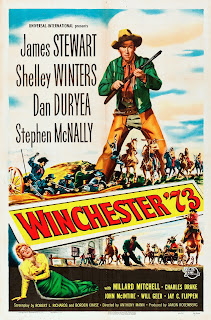
Winchester '73

Anthony Mann's Winchester '73 starts off like your standard western: Lin McAdam (James Stewart) and "High-Spade" Frankie Wilson (Millard Mitchell) pass through Dodge City while on the trail of Dutch Henry Brown (Stephen McNally). Lin and Dutch compete in a shooting contest, where Lin wins the titular rifle (and Dutch promptly steals it). And that's where the story kicks off.

A simple premise, yes, but that's not the point of Winchester '73. As Mann demonstrated with Raw Deal two years before, it's more about the characters in the story, how their interactions shift the narrative. It was something Mann was good at depicting.

Stewart -- now in the second stage of his career -- drifts away from his idealistic screen image in favor of something a little darker. As he showed previously with It's a Wonderful Life and Rope, Stewart displays a cynical streak in Lin. And as later shown in Vertigo, he also displays a menacing one.

And Winchester '73 is photographed beautifully, thanks to cinematographer William H. Daniels. Hot off the heels of an Oscar win for The Naked City the year before, he goes from the looming buildings of New York City to the open outdoors of the western frontier. You genuinely feel that you're there.

Winchester '73 brought back the dying genre with a vengeance. Other westerns throughout the decade would have that nasty streak coursing through them, a morality more in focus than in years before. And a lot of that can be traced back to Mann and his film.

My Rating: ****1/2

Monday, January 3, 2022

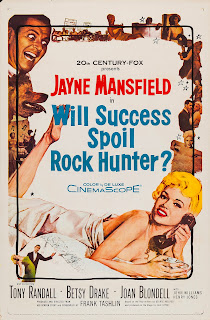
Will Success Spoil Rock Hunter?

You know how there are some movies that even after all these years still click. Their stars have long passed on, the politics of their day have shifted, and some elements aren't as risque or daring as they once were but regardless, they click. (Maybe Nietzsche was right about time being a flat circle.)

Frank Tashlin's Will Success Spoil Rock Hunter? -- while deviating from the premise of George Axelrod's original stage play -- is such an example. In the sixty-five years since its release, its satirical portrayal of celebrity and fan culture is all the more prevalent thanks to the advent of social media. (Good thing Tashlin isn't around to see fiction become reality.)

Being a former animator, Tashlin's background is very apparent throughout Will Success Spoil Rock Hunter? With enough visual gags that wouldn't look out of place in your standard cartoon, it shows that he was one of the more unique directors working at the time. It's little wonder that Tashlin was a mentor to Jerry Lewis.

On a similar note, there's enough fourth wall-breaking in Will Success Spoil Rock Hunter? to warrant calling a mason afterwards. Be it towards the stars' private lives or their professional ones, Tashlin's script spares no expense. (Man, comedies from the 1950s were something else, weren't they?)

Will Success Spoil Rock Hunter? starts to lose steam by the third act but Tashlin and the cast make it work nonetheless. Being made when sex comedies were becoming commonplace, it has the distinction of being just a touch classier than later titles. (Faint praise, granted.) Hey, the sexual revolution (and the MPAA's fruition) was only a few years away.

My Rating: ****

Thursday, July 16, 2020

The Perfect Furlough

Blake Edwards' The Perfect Furlough introduces Lt. Vicki Loren (Janet Leigh) in a way that's par for the course for films of the era: legs first. Shortly thereafter, we witness the arctic base Loren's team of psychiatrists is assigned to look after slowly going insane from the isolation, pin-ups on nearly every wall. As expected for an Edwards comedy, libido is the picture's driving force.

But what's this "perfect furlough" in question? The men at the base suggest being in Paris with movie star Sandra Roca (Linda Cristal). With a bit of scheming, Cpl. Paul Hodges (Tony Curtis) is the one that goes on furlough but thanks to his "record", Loren has to look after him. But what will ensue once in Paris?

With a script by Stanley Shapiro (who'd write the next Edwards and Curtis picture Operation Petticoat), there's a boatload of lines that just skirt past the censors of the day. (Having Elaine Stritch amongst the cast helps too.) Playing with Edwards' penance for visual gags, they make a strong combination. (It's a shame they didn't collaborate more.)

Being a picture starring real-life couple Curtis and Leigh (the fourth of five, and one of two from 1958), it's patently obvious that they'll end up together before the credits roll. But even with that in mind, it's interesting to see their screen personas interact. She's strait-laced to his freewheeling but as they spend more time together, she relaxes and he calms down. (One wonders if their marriage was similar; probably not, seeing as they divorced four years later.)

The Perfect Furlough is top-tier Edwards (the final third is where it loses steam) but it still holds up today. If there's one thing to take away from this, it's that you see Edwards making his bones in traits that are more prevalent with his comedies in the coming decade. (Mind you, they're more restrained than what was to come.)

My Rating: ****

Monday, December 18, 2017

Bell, Book and Candle

In 1958, James Stewart and Kim Novak teamed up for Vertigo, With his traditional ways and her allure, they made for an ideal pairing for Alfred Hitchcock. But did you know that the two actors were in another film that year?

That film for the record was Richard Quine's Bell, Book and Candle, and their roles here were actually similar to those in Hitchcock's. Stewart's Shep Henderson is your average Joe: good-paying job, quiet life, plans to get married. All of that goes right out the window when he crosses paths with the (literally) bewitching Gillian Holroyd (Novak).

Obviously, Bell, Book and Candle and Vertigo are two completely different films (the former a supernatural comedy, the latter a thriller). But aside from their lead stars, there are some similarities between the projects, the most telling being Stewart getting drawn to Novak's aloof nature.

Alongside Stewart and Novak in Bell, Book and Candle are the likes of Elsa Lanchester and Jack Lemmon, both as members of Gillian's family (she as her aunt, he as her brother). Obviously it's interesting casting (Lemmon in particular sports one hell of a manic grin most of the time) but of course this show belongs to Stewart and Novak.

Bell, Book and Candle may have gotten lost in the shadow of Vertigo but it has its own charms (so to speak). Stewart and Novak work wonderfully together, and Lanchester and Lemmon do much of the same. And with this being Stewart's last foray as a romantic lead (even the leading man can be affected by age), it provides one final glimpse of the performer from his prime. (It also serves as a reminder for the changing of the guard when it came to Hollywood's stars.)

My Rating: ****

Tuesday, November 14, 2017

The Blue Gardenia

Several minutes into Fritz Lang's The Blue Gardenia, and we watch Norah Larkin (Anne Baxter) preparing a birthday dinner for herself. She had recently gotten a letter from her fiance from overseas (he's serving in the Korean War) so she's got a spring in her step. But her happiness is quickly deflated when the letter tells her he's leaving her for a nurse that treated him.

Devastated, Norah goes to drown her sorrows at the titular restaurant with womanizer Harry Prebble (Raymond Burr). The next morning, she wakes up to a splitting headache, the events of the previous night a complete blank. And then news breaks of Harry's murder...

Lang was having a good year in 1953. As well as The Blue Gardenia, he also had The Big Heat released. And as he previously showed with M and Scarlet Street, noir was where he excelled. (Perhaps deploying some tricks he learned before leaving his native Vienna?)

And while she's known as the conniving titular character of All About Eve, Baxter was more than capable of playing vulnerable women. (After all, she won an Oscar for doing such a role in The Razor's Edge.) Her Norah is constantly on pins and needles following that night, fearing that she might be the one responsible for Harry's death. But is she?

The Blue Gardenia further the belief that Lang is one of several names synonymous with film noir. With ominous lighting and shadows doing the same, Lang also captures a public that's morbidly drawn to bloodshed and the kind of press it can conjure up. (The man sure knew how to make a picture, huh?)

My Rating: ****1/2

Monday, November 6, 2017

Born to Be Bad

Many of the roles Joan Fontaine played throughout her career could be best described as mousy. Whether it's her collaborations with Alfred Hitchcock or any of her films following them, it became a sort of typecasting for her. Granted, as is often the case with actors, sometimes there's a want for change.

Now Fontaine actually subverts her usual character type for Nicholas Ray's Born to Be Bad. Her Christabel Caine initially seems to be like the actress' former roles but her true colors emerge once she's settled in. She's not some shrinking violet; she's consumed by her status in society.

Being made the same year as Ray's more prolific noir In a Lonely Place, it's understandable as to why Born to Be Bad isn't as well-known. And admittedly it doesn't have the same quality as the more famous film but regardless of that fact, it's still intriguing to watch it unfold.

And Fontaine has a pretty solid lineup of co-stars for Born to Be Bad. It has the likes of Joan Leslie, Zachary Scott, Robert Ryan (no stranger to noir), and Mel Ferrer, showing that very common aspect with other titles of the 1950s: the star-studded feature. (And Ray himself would partake in that several times over.)

Born to Be Bad may not be top-tier Ray but as he showed with his debut They Live by Night the previous year, noir was where he excelled. And while Fontaine didn't regularly play such roles like Christabel, she's clearly having some fun vamping it up. (It would've been nice to see her in more parts like it.)

My Rating: ****

Sunday, November 5, 2017

Black Hand

"At the turn of the century, there were more Italians in New York than in Rome. Many had hurried here seeking fortune and freedom." So opens Richard Thorpe's Black Hand.

Years after his father's murder, Giovanni "Johnny" Columbo (Gene Kelly) seeks revenge from those responsible. A familiar premise within this genre, yes, but bear in mind both the leading man and the studio that made it. This wasn't common fare for either of them.

Similar to what Thorpe did with Night Must Fall thirteen years earlier, he lets an actor who's typecast get a chance to flesh out their resume. In this instance, Kelly -- who'd later show his worth as a serious actor the following decade with Inherit the Wind -- steps away from musicals to dabble in a more serious project. If only Kelly had more opportunities during his career.

And though Black Hand supposedly has the titular gang as the antagonist, it's actually the Italian mafia in that role designation. (The studio thought it'd be wiser -- and less death threat-inducing -- to have a dead organization as the villain than one that's thriving.) Still, that fact doesn't diminish the film too terribly.

Black Hand may not hold up to other titles of the decade but it still has its moments. As mentioned, Kelly proves he's more than a song and dance man. And like Night Must Fall, it can be absolutely fascinating to watch most of the time.

My Rating: ****

Saturday, October 28, 2017

Odds Against Tomorrow

The morality of people is something that can provide solid fodder if used properly. What can cause someone to betray both their beliefs and those close to them? And do they revert back to their old ways?

Robert Wise's Odds Against Tomorrow has this as the main dilemma for Johnny Ingram (Harry Belafonte). A family man with gambling debts, he reluctantly agrees to help David Burke (Ed Begley) in a bank robbery upstate. But co-conspirator Earl Slater (Robert Ryan) balks at working with someone who's black.

Naturally the main focus of Odds Against Tomorrow is the robbery but after nearly sixty years, what stands out is the depiction of race. Being released before the civil rights movement's peak, the matter was (and still unfortunately is) a hot-button topic. After all, actors like Belafonte (read: black) were just beginning to move away from servant roles and other stereotypes.

Similarly, there's a point in Odds Against Tomorrow where Johnny finds his wife hosting a PTA meeting in their home. He's offended that she's trying to behave more white. Usually such disgust towards another race has someone who's Caucasian expressing it (at least as far as fiction goes). It's not that common for someone non-white behaving that way. (In real life, however....)

Odds Against Tomorrow proves that while Wise is more known for West Side Story and The Sound of Music (and to some Star Trek: The Motion Picture), he certainly knew what to do with more serious material. (Adding to the film's noir ambiance are Shelley Winters and Gloria Grahame in supporting roles.) And man, Belafonte should've been a bigger name in Hollywood. (He was obviously a very talented man.)

My Rating: ****

Wednesday, October 18, 2017

The Tin Star

Early on in Anthony Mann's The Tin Star, bounty hunter Morg Hickman (Henry Fonda) arrives in a small town hoping to get a claim on a wanted man. His first impression of sheriff Ben Owens (Anthony Perkins) isn't a good one; he finds the younger man fumbling with his pistols. ("Just getting the feel of these guns.") This sets up the characterization of the two men.

And the casting of these two actors amplifies the circumstances of The Tin Star. Fonda is the more experienced actor, his Morg having a world weary attitude about him. Perkins -- having been in only four films prior to this -- has a green streak about him, much like Ben. And these are traits that would persist in their roles for the next decade.

Back to The Tin Star itself. Mann is certainly no stranger to this genre as his collaborations with James Stewart earlier in the decade can attest to. This was the genre that ensured Mann would not be forgotten years after his death in 1967. (Well, film noir too.)

Unsurprisingly, The Tin Star shares many elements with other westerns of the era: Morg romancing the widow, Ben's wife being concerned for her husband's safety, Lee Van Cleef as the villain...you know, the usual. (But hey, if the audience likes these tropes, give them what they want.)

The Tin Star is an enjoyable yarn from a year filled with heavier-themed films. (Fonda and Perkins also had 12 Angry Men and Fear Strikes Out that year.) Being released the same year as other westerns like 3:10 to Yuma and Gunfight at the O.K. Corral, it's understandable as to why it's not as known. But that shouldn't stop one from seeking it out.

My Rating: ****

Tuesday, September 12, 2017

It Should Happen to You

Gladys Glover (Judy Holliday) hasn't had the best day at the start of George Cukor's It Should Happen to You. She just lost her modelling job due to a slight shift in her measurements, and now she's despondent at losing her chance at becoming a somebody. Then she sees some available billboard space, and an idea pops into her head.

As she proved with her previous collaborations with Cukor, Holliday is the star of It Should Happen to You. Making the ditzy (not dumb) blonde her noted role, Holliday precedes Marilyn Monroe in making the character type her own. And no one could get the best of that character out of her than Cukor. (Just watch Adam's Rib or Born Yesterday.)

Also of note in It Should Happen to You is Jack Lemmon in his first major film role. As he would later show with his Billy Wilder collaborations, his Pete Sheppard keeps a can-do spirit despite being the universe's human punching bag. You just can't help but root for him.

In this day and age of people getting famous for the most menial of things, It Should Happen to You seems almost quaint. Of course those involved (Cukor, Holliday, Lemmon, Peter Lawford, et al.) aren't around to witness fiction becoming reality. (Lord only knows what it'd be like had they lived long enough to see the age of the internet.)

It Should Happen to You is deeply charming, which is something to be expected when Holliday and Lemmon are involved. Being released the same year as On the Waterfront and Rear Window (and Cukor's own A Star is Born), it's a nice breather from the heavier titles that year. (Is it ever wrong to go for Cukor as a pick-me-up?)

My Rating: ****

Tuesday, August 22, 2017

Too Much, Too Soon

There's a part in Art Napoleon's Too Much, Too Soon where John Barrymore (Errol Flynn) proclaims to his daughter Diana (Dorothy Malone) that alcoholism isn't genetic. As anyone who's familiar with that family's stormy history (or from simple psychology), they know that's far from the actual truth. And boy, does Diana learn that the hard way.

Based on her memoir, Too Much, Too Soon chronicles Diana's relationship with her famous father and how she inherited his bad habits instead of his acting abilities. (Her mother mentions that she'll only get famous because of her surname only.) And don't expect anything sugarcoated.

Being a recent Oscar winner for Written on the Wind, Malone follows the likes of Ray Milland and Susan Hayward in depicting problem drinking at its ugliest. She shows how low Diana is willing to scrape by (including doing lousy impressions at a seedy dive bar), looking for something to fill that emptiness in her life. And knowing that the real Diana died just two years later, it adds a tragic twist to the title.

The same can be said for Flynn, who died the following year. Here he is playing his former drinking buddy, and you have to wonder how much of his performance was merely himself. Now a bloated shadow of his former self, you can see the regrets of throwing it all away in his features. The line between these two lives is blurred greatly.

While Malone and Flynn's performances are solid, the same can't be said for the rest of Too Much, Too Soon. It does get overly dramatic after an hour (probably expected for a biopic on a Barrymore) and the ending's flimsy. Still, they tried their best (but not very well).

My Rating: ***1/2

Saturday, June 10, 2017

Fear Strikes Out

There are always those actors who get typecast. John Wayne and Clint Eastwood will always be the hero gunslinger, Sylvester Stallone and Arnold Schwarzenegger are the quintessential action movie stars, and Cary Grant and Gary Cooper were the epitome of the leading man. Of course there are other examples beyond these.

Take for instance Anthony Perkins. In the years since his 1992 death, audiences tend to acknowledge him as Norman Bates from Psycho. While there's no denying the greatness of his performance in it, that doesn't mean the rest of his filmography is to be ignored for the sake of that one. (He was an Oscar nominee, people!)

Interestingly, three years before Alfred Hitchcock's film, Perkins had a role where his character was under the thumb of a domineering parent. The role in question was baseball player Jim Piersall (who passed away last week) in Robert Mulligan's Fear Strikes Out, and there are similarities in how Perkins plays the two parts. (Pay attention to Jim's body language when he feels threatened.)

Though Fear Strikes Out is marketed as a biopic on Piersall's career, it's much more of a depiction of his stormy relationship with his father (Karl Malden). He's pushed beyond his means mentally to be the best at the sport, and you can see in some scenes him starting to crack under pressure. (Can you at all blame him for what happens?)

Fear Strikes Out is one of several prominent roles of Perkins' that's forever lost in the shadow of his most prolific one. It may not have the same punch it might have had when it was first released but what stands out after all this time is how the long-term effects of emotional abuse can affect more than the person who bore the brunt of it. (It's definitely cause for immense concern if it continues.)

My Rating: ****

Friday, March 24, 2017

The Cobweb

Ah, the star-studded productions of the 1950s. Basically the easiest way for studios to re-coup the budget and earn a tidy profit. And sometimes said production doesn't always need the best of scripts for its actors.

And boy, is that last detail on full display in Vincente Minnelli's The Cobweb. More than once the actors' dialogue sounds either stiff or overwrought, admittedly not an unheard of fault in some films from the same time. Still, at least some of the many big names of the film rein it in towards the overall flimsy script.

But whom is amongst the cast of The Cobweb? An enviable roster of performers, that's for sure: Richard Widmark, Lauren Bacall, Gloria Grahame, Charles Boyer and Lillian Gish. But of the names that stand out amid a rather forgetful project is John Kerr. (Also of note is Oscar Levant -- himself a victim of his own neuroses -- in an inspired bit of casting.)

With a Best Picture winner (and a failed marriage to Judy Garland) under his belt, one would think Minnelli would be able to salvage The Cobweb, especially considering the film's primary location. But even with the various ups and downs in the director's personal life, perhaps his lack of conveying them into the film only adds to the production's faults. (Maybe Douglas Sirk would've been a better fit at the helm?)

The Cobweb could've been a continuation of Minnelli's transition into more serious fare but the shaky script prevented that from even remotely becoming a reality. (At least he had more luck the following year with Lust for Life.) The cast does try their damnedest to make it work to little avail. (Similarly, at least some of them were more successful with later projects.)

My Rating: ***

Saturday, December 31, 2016

Outrage

Life seems good for Ann Walton (Mala Powers) initially in Ida Lupino's Outrage. Recently engaged, she's happy with how things are going for her. But after she gets raped, she feels like those around her are judging her. How will Ann recover?

Unsurprisingly Outrage cause a little bit of the film's namesake upon its release. It being the second film at the time to have rape as its main topic (the first being Johnny Belinda), it sure as hell doesn't sugarcoat the matter. (With a woman at the helm, that's even more clear.)

And Lupino completely avoids any form of victim blaming towards Ann, who's treated with sympathy by those that know her. (Any type of disgust for what happened is directed towards her attacker.) But even with condolences, Ann still feels like she's being judged.

Even after she runs away, Ann finds some difficulty in regaining order in her life. Again, she's met with sympathy by the people she encounters (but not generally everyone). But slowly she gets a new perspective on the world she's a part of. (Her eyes do lose that spark of innocence.) It's a tough road for Ann to go down, yes, but no one ever said life itself would be without its problems.

Outrage continues to show what Lupino could depict both as a woman and a director. (How many directors -- male or female -- focus on the matter of assault outside of shock value and cheap drama?) As she showed a few years later with The Bigamist, Lupino showed that she was interested in subject matter that no one at the time would touch with a ten-foot pole. (Clearly her career as a director should be held in higher regard.)

My Rating: ****

Friday, December 30, 2016

Kings Go Forth

The usual formula for Hollywood fare back in the 1950s often followed these elements: get a couple of big names in top billing, have a nice blend of action and romance, and keep it all under two hours. (The latter is ignored when epics are involved.) Seriously, randomly pick out five titles from the decade, and at least three of them fall under this type of picture.

Delmar Daves' Kings Go Forth ticks off every box. It has a story told many times before (two men fighting over a woman) but does it manage to stand out from similar works? (It's also set during World War II, another common setting amongst films at the time.)

Amongst its top-billed stars are Frank Sinatra, Tony Curtis and Natalie Wood, all of whom had established themselves as serious actors in previous years (Sinatra in From Here to Eternity, Curtis in Sweet Smell of Success, Wood in Rebel Without a Cause). Though here in Kings Go Forth, they don't really have much to do here. (A paycheck project for one or all three of them, perhaps?)

But a major theme throughout Kings Go Forth is racism (Wood's character is of mixed race). But the film is more interested in the romantic rivalry at hand than any form of social commentary. (At least Curtis did The Defiant Ones the same year.)

Kings Go Forth is more or less the expected fare of the time, requiring its location to be exotic and its actors to look impeccable. Substance-wise the film doesn't have much to offer but still, it's a good enough escape from reality. (Hey, it had tough competition that year.)

My Rating: ***1/2

Tuesday, November 22, 2016

Angel Face

After years of being under the thumb of the studio system, you could tell in some of his films that Otto Preminger wanted to break free. Indeed in the years to come he would regularly push the envelope with what the Hays Code would allow. But his films under the system don't become irrelevant, not in the least.

One such title from that time was Angel Face. Though not as well-known as Preminger's other famed noir Laura, it's still proof that noir was where he was his best. After all, he seemed to better grasp the psychology aspect of the genre.

Like Laura, Angel Face explores obsession but this one shows a more unhealthy depiction of it. When we first meet Diane Tremayne (Jean Simmons), it's clear that there's something off about her. And as Frank Jessup (Robert Mitchum) learns the hard way, it's best if one doesn't get close to her.

Of course having Mitchum is film noir is practically to be expected but it's Simmons who's an inspired bit of casting. No longer is she the proper English lady she played time and time again throughout her career. If only Hollywood gave her a chance by letting her play the femme fatale more often.

Angel Face is proof that Preminger was the premier back then for dark material. (He most definitely didn't give a damn what censors thought of his work; he wanted to shock his audience in a way different from Hitchcock.) He may be a mostly forgotten name nowadays but when you see a film by Preminger, it's very seldom one that'll be forgotten easily.

My Rating: ****

Saturday, November 12, 2016

The Steel Helmet

There are two types of war films: the ones more reliant on bloodshed and the ones more reliant on morality. Obviously it's those in the category that tend to stand out more to audiences, what with how the soldiers behave under duress. There's always been a morbid fascination towards living in fear for one's life.

Unsurprisingly there was a large flux of such works in the years after World War II, many of them penned by those who lived to tell their tales. One such name was Samuel Fuller, and it was his third film The Steel Helmet that put him on the cinematic map.

As would do with later films like Pickup on South Street and The Naked Kiss, Fuller shows with The Steel Helmet a good deal of grit. There's no denying there was a shift in storytelling following the end of World War II, and Fuller proved so as the Korean War raged on. He didn't want to make a sappy picture.

Similarly, much like his magnum opus The Big Red One, Fuller avoids all forms of bullshit for The Steel Helmet. (It's a war movie, damn it, not a soap opera.) He -- as well as several of the film's actors -- knew firsthand what war was like; they sure as hell don't want to sugarcoat their experiences.

The Steel Helmet makes for a solid character study as well as a war film. (What better way to show one's true colors than by putting them in a life or death situation?) It also showed Hollywood what to expect from Fuller, someone who actively tried to change the game. (He did.)

My Rating: ****1/2