Showing posts with label director: Anthony Mann. Show all posts

Tuesday, January 4, 2022

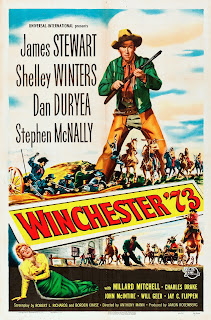
Winchester '73

Anthony Mann's Winchester '73 starts off like your standard western: Lin McAdam (James Stewart) and "High-Spade" Frankie Wilson (Millard Mitchell) pass through Dodge City while on the trail of Dutch Henry Brown (Stephen McNally). Lin and Dutch compete in a shooting contest, where Lin wins the titular rifle (and Dutch promptly steals it). And that's where the story kicks off.

A simple premise, yes, but that's not the point of Winchester '73. As Mann demonstrated with Raw Deal two years before, it's more about the characters in the story, how their interactions shift the narrative. It was something Mann was good at depicting.

Stewart -- now in the second stage of his career -- drifts away from his idealistic screen image in favor of something a little darker. As he showed previously with It's a Wonderful Life and Rope, Stewart displays a cynical streak in Lin. And as later shown in Vertigo, he also displays a menacing one.

And Winchester '73 is photographed beautifully, thanks to cinematographer William H. Daniels. Hot off the heels of an Oscar win for The Naked City the year before, he goes from the looming buildings of New York City to the open outdoors of the western frontier. You genuinely feel that you're there.

Winchester '73 brought back the dying genre with a vengeance. Other westerns throughout the decade would have that nasty streak coursing through them, a morality more in focus than in years before. And a lot of that can be traced back to Mann and his film.

My Rating: ****1/2

Saturday, September 26, 2020

Raw Deal

The narration from Pat Regan (Claire Trevor) in Anthony Mann's Raw Deal shows an undying loyalty to Joe Sullivan (Dennis O'Keefe) as she helps him escape from prison. But when his caseworker Ann Martin (Marsha Hunt) becomes a begrudging accomplice (they need another getaway car), it then drips with jealousy as Pat fears the presence of the other woman.

If anything, Raw Deal is less about a criminal on the run as it is about the people they've encountered. Be it the women that love him or the men that betrayed him, the film shows how those that encounter Joe invariably have their lives changed. And more often than not, it isn't for the better.

Along with westerns, film noir was the genre where Mann thrived. As he would do with Side Street soon after, he shows a keen eye towards the darkness within humanity. Some become resigned to the fact that illegal activity is how they'll survive in the world while others fully embrace this new life.

And boy, does Raw Deal live up to its title. Its morality is a murky gray at best, neither black nor white. John Alton's cinematography exemplifies this atmosphere, the shadows playing as much of a role as the actors. (The fact that Alton was recognized only once by AMPAS -- though thankfully won -- is something of an insult when it comes to cinematography.)

Raw Deal marked a decided change in how Hollywood told stories. Titles in the years to come had a streak of danger to them, their way of seeing how far they can push the envelope. And Mann was the one who instigated this shift. (Just look at the westerns he made with James Stewart a few years later.)

My Rating: ****1/2

Wednesday, October 18, 2017

The Tin Star

Early on in Anthony Mann's The Tin Star, bounty hunter Morg Hickman (Henry Fonda) arrives in a small town hoping to get a claim on a wanted man. His first impression of sheriff Ben Owens (Anthony Perkins) isn't a good one; he finds the younger man fumbling with his pistols. ("Just getting the feel of these guns.") This sets up the characterization of the two men.

And the casting of these two actors amplifies the circumstances of The Tin Star. Fonda is the more experienced actor, his Morg having a world weary attitude about him. Perkins -- having been in only four films prior to this -- has a green streak about him, much like Ben. And these are traits that would persist in their roles for the next decade.

Back to The Tin Star itself. Mann is certainly no stranger to this genre as his collaborations with James Stewart earlier in the decade can attest to. This was the genre that ensured Mann would not be forgotten years after his death in 1967. (Well, film noir too.)

Unsurprisingly, The Tin Star shares many elements with other westerns of the era: Morg romancing the widow, Ben's wife being concerned for her husband's safety, Lee Van Cleef as the villain...you know, the usual. (But hey, if the audience likes these tropes, give them what they want.)

The Tin Star is an enjoyable yarn from a year filled with heavier-themed films. (Fonda and Perkins also had 12 Angry Men and Fear Strikes Out that year.) Being released the same year as other westerns like 3:10 to Yuma and Gunfight at the O.K. Corral, it's understandable as to why it's not as known. But that shouldn't stop one from seeking it out.

My Rating: ****

Thursday, November 26, 2015

Side Street

Anthony Mann's Side Street opens with the narration of police officer Walter Anderson (Paul Kelly), talking about the many lives within the confines of New York City. He muses how the vast city's inhabitants will pass each other by without a second thought, how they carry on with their routine lives. Then we're introduced to Joe Norson (Farley Granger).

With his wife expecting, Joe is tightly strapped for cash. (His part-time job as a mail carrier isn't helping much.) During one of his routes, he steals what he thinks is $200 from a lawyer's office. He then finds out he actually stole $30,000. What follows has Joe ensnared with criminals and murder.

Like any good film noir, the city plays just as big a part as any of the actors. And it's all crisply captured by Joseph Ruttenberg, who was certainly no slouch when it came to his job. (He didn't get four Oscars and six additional nominations for nothing.) The hustle and bustle of this restless town is keenly shot by his and Mann's watchful eyes. God, to live in that world...

Granger, far from an unfamiliar face to films of a criminal nature (Rope, They Live by Night, Strangers on a Train), is great here. With his frantic dark eyes, he captures Joe's tense disposition. Surely Granger must've known how others might see the film even if he didn't think much of it. (From his autobiography: "For its time, Side Street was a good-looking, well-made film that was not able to rise above the banality of its story.")

Side Street is a really, really damn good noir, one that for some reason hasn't earned the recognition it deserves. (Then again, this could apply to most of Granger's filmography outside of his collaborations with Alfred Hitchcock.) So be sure to find this and watch it.

My Rating: *****