Many of Jean-Pierre Melville's films revolve around the criminal underworld or simply people who go against what the government wants. The characters usually have no feelings for society or other people, sort of like the director himself.
However, his film Leon Morin, Priest is different from Army of Shadows or Le samourai. The film revolves around the one thing the characters in Melville's other films would merely scoff: religion. And like many films about religion, Leon Morin, Priest focuses on an individual wrought by a sort of religious belief.
In this case, the individual is Barny (Emmanuelle Riva), a widow with a young daughter. She finds solace in the teachings of Father Morin (Jean-Paul Belmondo). However, as time wears on, she becomes less concerned about the teachings and more about Father Morin.
Leon Morin, Priest is not afraid to show emotion unlike Melville's other more aloof films. It's also different because the main protagonist is female rather than a chauvinistic male. It's really a far cry from anything Melville would later do; that's what makes it stands out.
Leon Morin, Priest is a very compelling film to watch. In less than two hours, the viewer watches a woman go from non-believer to witness to of a vision to God fearing. And Riva makes this performance her own. Belmondo, famous for his nonchalant role in Breathless, gives an equally transfixing performance. And Melville shows he can do more than American-influenced crime films.
My Rating: *****
Showing posts with label director: Jean-Pierre Melville. Show all posts
Monday, July 9, 2012
Sunday, February 26, 2012
Le Cercle rouge
The two main characters of Jean-Pierre Melville's Le Cercle rouge are both criminals. One is fresh out of jail, the other is on the run. Both are distant from any sense of emotion, but they both know how to calculate the perfect crime.
The newly released prisoner is Corey (Alain Delon). His expression never changes throughout the course of the film. He remains blank, devoid of anything. He possesses a permanent steely stare, surveying everyone and everything around him.
The escapee Vogel (Gian Maria Volonte), however, is the opposite of Corey. He's on edge, watching every move he makes. When it comes to planning the heist, he leaves all the work to Corey. He knows Corey knows what he's doing.
The curious thing about Le Cercle rouge is that Melville doesn't mention what crimes got Corey in jail and Vogel arrested. Not even a slight hint. What could it have been? Robbery? Kidnapping? Murder? Again, no one knows. That adds to the allure of the film.
Le Cercle rouge is very good. Not as great as Army of Shadows, but on a similar level. Again, Melville knew how to capture the criminal underworld, and this is solid proof.
My Rating: *****
The newly released prisoner is Corey (Alain Delon). His expression never changes throughout the course of the film. He remains blank, devoid of anything. He possesses a permanent steely stare, surveying everyone and everything around him.
The escapee Vogel (Gian Maria Volonte), however, is the opposite of Corey. He's on edge, watching every move he makes. When it comes to planning the heist, he leaves all the work to Corey. He knows Corey knows what he's doing.
The curious thing about Le Cercle rouge is that Melville doesn't mention what crimes got Corey in jail and Vogel arrested. Not even a slight hint. What could it have been? Robbery? Kidnapping? Murder? Again, no one knows. That adds to the allure of the film.
Le Cercle rouge is very good. Not as great as Army of Shadows, but on a similar level. Again, Melville knew how to capture the criminal underworld, and this is solid proof.
My Rating: *****
Saturday, February 25, 2012
Army of Shadows
Jean-Pierre Melville was an interesting sort of director. On the one hand, he knew how to depict the criminal lifestyle. (Or at least from what I've seen by him so far.) Yet on the other hand, there is that detached aura in his work.
Such is the case with Army of Shadows, perhaps Melville's most highly regarded work. We are introduced to an array of people yet we can't really develop feelings for any of them. This isn't a bad thing, mind you, but rather as a better way to grasp the story of it all.
But what is the story of Army of Shadows? There isn't one specific story but rather many of them. All of them have one major connection: the French Resistance, which Melville himself was a part of. The aura of detachment is also in affect here. Melville was detached by his country's government, so he put that feeling into his film.
Army of Shadows was released barely a year after the student riots of May 1968. (No surprise that the film wasn't much of a success in France.) The politics in the film and those on focus in the protests are one in the same. The power of the government becomes too much for its citizens, so they decide to fight back.
Army of Shadows is neither a history lesson nor a war film. Think of it more as Melville's memories of the Resistance. Also, those 144 minutes just fly by, just as any great film should.
My Rating: *****
Such is the case with Army of Shadows, perhaps Melville's most highly regarded work. We are introduced to an array of people yet we can't really develop feelings for any of them. This isn't a bad thing, mind you, but rather as a better way to grasp the story of it all.
But what is the story of Army of Shadows? There isn't one specific story but rather many of them. All of them have one major connection: the French Resistance, which Melville himself was a part of. The aura of detachment is also in affect here. Melville was detached by his country's government, so he put that feeling into his film.
Army of Shadows was released barely a year after the student riots of May 1968. (No surprise that the film wasn't much of a success in France.) The politics in the film and those on focus in the protests are one in the same. The power of the government becomes too much for its citizens, so they decide to fight back.
Army of Shadows is neither a history lesson nor a war film. Think of it more as Melville's memories of the Resistance. Also, those 144 minutes just fly by, just as any great film should.
My Rating: *****
Thursday, February 23, 2012
Le Doulos
Jean-Pierre Melville's Le Doulos was probably one of the few early films that depicted lives both on the run and behind the badge. Of course, this was before Sidney Lumet depicted such lives.
The criminals take their sweet time in planning their crimes, making sure every detail works in the long run. But as we all know from countless crime movies, not everything pans out as it should.
On the flip side, the police have to be at the top of their game. After all throughout Le Doulos, sometimes the criminals are a step ahead of the police. The other times, however, the police know everything.
The switching from criminal to police is a nice touch. Decades before Martin Scorsese did such a thing with The Departed, Melville does a nice examination of both sides of the track. However, he does tend to focus on one more than the other.
Le Doulos is a fine portrait of the criminal life. It has its flaws, such as underdeveloped characters and a primary focus on violence. Still though, Melville shows his audience the very thin line between law breakers and law makers.
My Rating: ****1/2
The criminals take their sweet time in planning their crimes, making sure every detail works in the long run. But as we all know from countless crime movies, not everything pans out as it should.
On the flip side, the police have to be at the top of their game. After all throughout Le Doulos, sometimes the criminals are a step ahead of the police. The other times, however, the police know everything.
The switching from criminal to police is a nice touch. Decades before Martin Scorsese did such a thing with The Departed, Melville does a nice examination of both sides of the track. However, he does tend to focus on one more than the other.
Le Doulos is a fine portrait of the criminal life. It has its flaws, such as underdeveloped characters and a primary focus on violence. Still though, Melville shows his audience the very thin line between law breakers and law makers.
My Rating: ****1/2
Wednesday, February 22, 2012
Bob le Flambeur
We've heard of countless American directors naming those from foreign countries as influences. (Do the names Bergman and Fellini ring a bell?) What about the other way around?
In this case, it's Jean-Pierre Melville. He was an admirer of all things American. (His surname is, of course, in reference to the author of Moby Dick.) But what he loved most from American culture were its films, Howard Hawks and John Ford in particular.
Naturally, Melville's love of American film would contribute as an influence for his own work. Such is the case with Bob le Flambeur, which many consider the beginning of the French New Wave. The main character of Bob Montagne (Roger Duchesne) in a few early scenes wears a fedora and a trenchcoat in a similar manner to that of Humphrey Bogart. The use of seedy locales implicates that Melville had his fair share of film noir.
What makes Bob le Flambeur so interesting (and an influence on films in the years to come) is that it gives the audience time to learn of the characters' personalities. Only bits of the robbery's planning are shown throughout rather than showing the actual crime. Slick move to be honest.
Bob le Flambeur is very good, though it does feel slow in parts. However, one can pick up as to how both the film and Melville are now considered influences. That alone is worth a look.
My Rating: ****1/2
In this case, it's Jean-Pierre Melville. He was an admirer of all things American. (His surname is, of course, in reference to the author of Moby Dick.) But what he loved most from American culture were its films, Howard Hawks and John Ford in particular.
Naturally, Melville's love of American film would contribute as an influence for his own work. Such is the case with Bob le Flambeur, which many consider the beginning of the French New Wave. The main character of Bob Montagne (Roger Duchesne) in a few early scenes wears a fedora and a trenchcoat in a similar manner to that of Humphrey Bogart. The use of seedy locales implicates that Melville had his fair share of film noir.
What makes Bob le Flambeur so interesting (and an influence on films in the years to come) is that it gives the audience time to learn of the characters' personalities. Only bits of the robbery's planning are shown throughout rather than showing the actual crime. Slick move to be honest.
Bob le Flambeur is very good, though it does feel slow in parts. However, one can pick up as to how both the film and Melville are now considered influences. That alone is worth a look.
My Rating: ****1/2
Monday, November 8, 2010
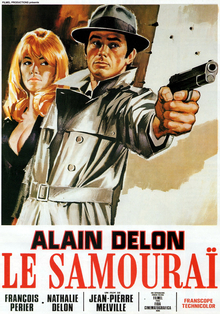
Le Samourai
Of the number of foreign films I've seen, the one language that is the most popular is French with three films. Those three are The 400 Blows, The Diving Bell and the Butterfly and Le Samourai.
Jef Costello (Alain Delon) is a contract killer who knows how to get away with the perfect crime. But his most recent hit left him with several witnesses, a police officer determined to arrest him and a vengeful boss.
Yowza, Delon is sexy in this. Talk about killer looks. Le Samourai is sleek and chic. Jean-Pierre Melville shows 1960s France in both a flattering and unflattering light. Flattering for the lifestyle of the time; unflattering for its depiction of law, showing police officers straining to get their man. But still, Le Samourai is a diverse entry of the French New Wave.
My Rating: ****1/2
Jef Costello (Alain Delon) is a contract killer who knows how to get away with the perfect crime. But his most recent hit left him with several witnesses, a police officer determined to arrest him and a vengeful boss.
Yowza, Delon is sexy in this. Talk about killer looks. Le Samourai is sleek and chic. Jean-Pierre Melville shows 1960s France in both a flattering and unflattering light. Flattering for the lifestyle of the time; unflattering for its depiction of law, showing police officers straining to get their man. But still, Le Samourai is a diverse entry of the French New Wave.
My Rating: ****1/2
Subscribe to:
Posts (Atom)