Showing posts with label 1970s. Show all posts

Saturday, January 3, 2026

The Texas Chain Saw Massacre

Right off the bat, Tobe Hooper's The Texas Chain Saw Massacre shows that it's not in the vicinity of messing around. After all, this was a post-Night of the Living Dead world Hollywood was working in. Gone were the days of horror playing it safe -- there was some fresh blood on the scene, and they wanted to see it spill.

Now The Texas Chain Saw Massacre was made when anyone with a working camera and a decent enough script could make a movie, the clutches of the big studios having weakened with the creation of the MPAA. Hooper was fortunate to have arrived on the scene at this time, showing that his idea co-penned with Kim Henkel hit a nerve with audiences. (Case in point, this was nearly rated X -- the harshest rating the MPAA could dole out at the time -- for how grisly it was.)

The theme in The Texas Chain Saw Massacre of something wicked lurking beneath everyday life (as also seen in Hooper's later film Poltergeist) had also played a part in Hooper's own life, courtesy of an event that happened in his native Texas as he attended college. In August 1966, a gunman opened fire on the campus, with a police officer telling Hooper to stay put -- and promptly getting shot dead near Hooper moments later. Fact can be scarier than fiction.

Like Psycho the previous decade, The Texas Chain Saw Massacre used the actions of Ed Gein as inspiration -- more specifically, the gruesome horror show the police had stumbled upon within Gein's home. The sheer depravity of Gein's broken mind is recreated by Hooper, showing how one's normalcy can mask something truly unholy. (Again, also seen in other Hooper titles.)

The Texas Chain Saw Massacre indicated (and vindicated) that there was a drastic change within Hollywood underway, one that wanted the guts (both figurative and literal) to be on full display. And with Jaws the following year, it was raw and unflinching, proving that the Hollywood of the previous generation was long gone. And a new one was just getting started.

My Rating: *****

Thursday, June 5, 2025

Fun with Dick and Jane

The opening credits of Ted Kotcheff's Fun with Dick and Jane shows how the titular couple grew up, met, and settled into the American Dream. A comfy life, for sure...and then Dick (George Segal) gets sacked from his job. Soon, he and Jane (Jane Fonda) struggle to both make ends meet and keep up appearances.

But desperate times call for very desperate measures. Dick comes up with committing robberies to keep food on the table. Jane gets involved as well, and things seem to be going well. But how long can they keep this up?

Made during a time where everyone was feeling financial strain, Fun with Dick and Jane probably seemed absurd to certain audiences upon its release. In hindsight, however, it paints a far more cynical picture. Once one reaches a particular standing in society, others feel schadenfreude at seeing them fall from grace.

Speaking of, Fun with Dick and Jane portrays its setting as a dog-eat-dog world. You have to stoop to levels you'd normally never stoop to. Your self-respect takes a backseat as you try to survive. And after a while, you don't recognize your own reflection.

Fun with Dick and Jane still holds up after nearly a half a century. Aside from a few jokes that aged like milk in the August afternoon sun, you could remake this beat for beat. Just goes to show that the more things change, the more things stay the same.

My Rating: ****

Wednesday, June 4, 2025

The In-Laws

Comedy is a hard thing to get right. What's funny in one decade could be seen as offensive in the next decade. It's all a matter of making sure you hit your mark without any mistakes along the way.

So you could imagine the undertaking Andrew Bergman went through in writing Arthur Hiller's The In-Laws. A few years after the success of Blazing Saddles (he co-wrote it), he was tasked with writing the script for a picture that was to star Peter Falk and Alan Arkin. (It was initially going to be a sequel to Freebie and the Bean, which had also starred Arkin.) Knowing the potential that could be mined from the two actors, Bergman took on the opportunity.

While a little slow in its build-up, The In-Laws goes out on all pistons running. Falk plays with his Columbo persona, seemingly not all there but very much is. Arkin, meanwhile, plays the straight man to Falk beautifully. It's a shame the two didn't work together more after this.

Now Hiller isn't the kind of director you'd associate with this type of picture, having made Love Story earlier in the decade. But bear in mind that just three years earlier, Hiller made Silver Streak, which starred Gene Wilder and Richard Pryor. He may not have done comedy often during his career but Hiller knew how to get the beats down.

The In-Laws may be one of the more underappreciated comedies of the last half century. It takes someone who really knows what they're doing to get something like this right. Thankfully, it's directed by, written by, and stars such people.

My Rating: ****1/2

Tuesday, January 2, 2024

Suspiria

At first glance, Dario Argento's Suspiria appears seemingly innocuous. Suzy Bannion (Jessica Harper) arrives in Germany to attend a dance academy. But it becomes clear that as soon as she steps out of the airport something's...off.

Indeed, the general feeling of Suspiria is that something just isn't quite right. And Argento ensures that throughout, be it with the music (courtesy of him and Italian band Goblin) or simply the staging of the scene, there's that lingering sensation that all is not what it seems. And it isn't.

Made during a time when the horror genre was getting (pardon the pun) fresh blood, Suspiria -- amongst his other titles of the time -- showed that Argento was on that roster. Amid the likes of Brian De Palma and John Carpenter, he shows a more lurid fascination with bloodshed. Who'd have thought there's a beauty in it?

Akin to Cat People back in 1942 (and The Brood two years later), Suspiria revels in unease amid normalcy. Everything should be completely fine but that nagging feeling keeps gnawing at our lead. But how long until that question of "what's wrong?" gets cruelly answered?

Suspiria is a barrage on the senses in the best way possible. Argento immortalizes himself with a film that lingers in the mind long after watching it. And it's little wonder that there have been many admirers and imitators over the years; it's just there can only be one version of it.

My Rating: *****

Wednesday, January 5, 2022

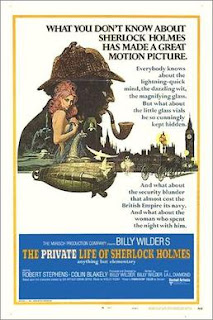
The Private Life of Sherlock Holmes

As the opening credits of Billy Wilder's The Private Life of Sherlock Holmes roll, the personal effects of John Watson (Colin Blakely) are examined. Among them are letters from Watson to his heirs. One of those letters talks about his days with Sherlock Holmes (Robert Stephens).

Wilder was a Holmesian and had tried unsuccessfully twice before to make an adaptation. (A musical, no less!) Now finally given the opportunity, he and I.A.L. Diamond initially came up with a film that ran over three hours long. It's this heavy editing that makes the final product clunky; you can tell that it's missing something in its flow.

While not as strong as prior Wilder-Diamond collaborations, The Private Life of Sherlock Holmes has a certain charm to it. The film serves as both a parody and a deconstruction of Sir Arthur Conan Doyle's most famed (and most personally loathed) creation. It's little wonder it served as inspiration for Steven Moffat and Mark Gatiss when they made Sherlock.

That said, the film doesn't have Wilder's particular touch to it. Lacking the sharp cynicism and sardonic wit usually found in the director's work, it also has elements that are out of place for both Wilder and Doyle. Still, there's a particular amusement amid the oddity.

The Private Life of Sherlock Holmes may not be top-tier Wilder but seeing Hollywood was beginning a new movement, he shows that he's not going to retire like his contemporaries just yet. (He'd make four more movies after this.) That being said, it was clear that he was becoming old hat. Oh, well; nobody's perfect.

My Rating: ***1/2

Monday, August 6, 2018

Hester Street

Stories of beginning a new life are by no means an uncommon occurrence in either fiction of real life. Many of these tales hail from those emigrating to America, hoping to thrive in the land of opportunity. Of course, these streets paved with gold may end up looking a bit tarnished to some.

Joan Micklin Silver's Hester Street provides two such perspectives from someone who's made themself at home within American culture and someone who has a harder time in doing so. The former applies to Yankel (Steven Keats) -- who has rechristened himself "Jake" -- and the latter is his wife Gitl (Carol Kane), who has recently arrived from Russia with their son. But he's gotten a mistress during their few years apart...

Silver was moved by Hester Street's source novel -- Abraham Cahan's Yekl: A Tale of the New York Ghetto -- because her parents were Russian Jews, prompting her to tell this story. (As well as changing the title, she changed the story's point of view from Jake to Gitl.) She felt it served as an ode to her heritage, and that's why Silver wanted this story to be told.

Their names aside, there are noted differences between Jake and Gitl. He has all but discredited his faith in favor of living the American way whereas she holds the one thing from the old world close to her heart. Were it not for their son, their relationship would have been over long before their emigration took place.

Hester Street is very much Silver's sonnet to where she came from, yes, but it's also a story of those who strive for a new life. Whether it's the past century or this current one, many of us have that desire to begin anew. But very seldom do we all achieve that possibility, especially one with a happy resolution.

My Rating: ****

Wednesday, October 25, 2017

The Last Detail

With the arrival of New Hollywood generation, a sense of cynicism became prevalent in the works from this time. It makes sense actually; with a senseless war raging on, the economy wasn't generally in the best of shape, and politics being like-minded with other events, it's no wonder such attitudes were channeled.

And Hal Ashby's The Last Detail particularly captures such a sensation. Being a post-Watergate release, it shows a disillusionment towards various establishments. And this was when baby boomers were beginning to rebel the previous generation's ideals so this just seemed like good timing for it.

Like what he did with Coming Home five years later, Ashby depicts an America just trying to carry on in life despite what's happening around them. They eat, they sleep, they have sex...just the general basics some people have and do on a regular basis. (It may not be much but it's how some stay connected to the world.)

Being made just a few years after Robert Altman found success with M*A*S*H, it's possible Ashby wanted to repeat those results with The Last Detail. After all, both are dark comedies with an ongoing war as its backdrop so it's not too much of a stretch. (The difference, of course, being which war was ensuing and where the military men were situated.)

Anyway, The Last Detail serves as a sort of timepiece for the era it hails from. This was a time where one's guard was generally lowered on a daily basis, again perhaps because of the collective embitterment from everyday life. And that's what stands out the most nearly forty-five years later: how the small joys in life aren't enough to combat reality.

My Rating: ****

Saturday, October 21, 2017

Diary of a Mad Housewife

The first exchanges in Frank Perry's Diary of a Mad Housewife make it clear that Tina Balser (Carrie Snodgress) isn't living the American dream. Her husband Jonathan (Richard Benjamin) treats her like garbage (their daughters aren't any better) and she never gets the support she deserves. Frustrated, she starts an affair with writer George Prager (Frank Langella). And even that's no walk in the park.

From a time when women were starting to be viewed as actual human beings, it seems strange that Diary of a Mad Housewife was released then. For once since who knows when women could lead liberating lives without (for the most part) getting berated. So to see an educated woman allow herself to be verbally degraded regularly is discomforting, to say the least.

And bear in mind that by this point in Hollywood, women were having their voices heard more behind both the typewriter and the camera. (Released the same year as Diary of a Mad Housewife was Wanda, Barbara Loden's lone foray as a director.) With the likes of Elaine May and Barbara Kopple on the cusp of their own fame, again it feels strange to watch this with that in mind.

But what's more likely is that Diary of a Mad Housewife is told from Tina's point of view. She's the only character in the film that's basically in every scene so it's hard to say if that's actually how she's treated. (More telling since Sue Kaufman's source novel was adapted by Perry's then-wife Eleanor -- whom he divorced the following year -- so who knows?)

Anyway, Diary of a Mad Housewife may seem tame by today's standards (and in comparison to other films of the decade) but back in 1970, it must've caused a stir upon its release. (Groucho Marx was certainly not a fan of it.) Either way, it captured an ignored woman on the verge of a nervous breakdown.

My Rating: ****

Tuesday, July 18, 2017

Monty Python's Life of Brian

If there's anything that's absolute fodder for immediate controversy, it's any depiction of religion. Anything where the merit of such beliefs are questioned, there will be an uproar of some magnitude. (Even for those that only examine the subject very briefly.)

Once one has seen Terry Jones' Monty Python's Life of Brian, they may not be at all surprised that it was met with some scorn. (The last scene is probably the most audacious thing the comedy troupe had put on film.) But at the same time, it provides a surprisingly smart commentary on the hypocrisy within religion.

Much like the previous endeavors of the sextet, they provide many of the roles in Monty Python's Life of Brian and again have Graham (ironically) as the titular straight man amid the absurdity. That's not to dis the casting decision but it would've been interesting to see a change in their usual lineup. (John Cleese lobbied for the lead before the others convinced him to let Chapman play Brian.)

But let's muse on Chapman for a moment longer, shall we? What would've become of his career had he not died from cancer in 1989? Would he have continued with comedy or would he have ventured into more serious material? It's been almost thirty years since his passing but the questions still linger.

Anyway, Monty Python's Life of Brian still holds up nearly forty years later. It may be (somewhat) more serious than Monty Python and the Holy Grail but that's possibly because of the group's change in style. As any good comedy can prove, it has to be both progressive and accessible to the masses throughout the coming years. And the Pythons have done just that with their many contributions.

My Rating: ****1/2

Thursday, February 16, 2017

Husbands

We're only young once in our short lives. It's once it's all over that we realize that there's not much time left on this planet. And boy, do mid-life crises make for excellent fodder when it comes to fiction.

That certainly comes to a head in John Cassavetes' Husbands. Following the sudden death of their friend, Gus (Cassavetes), Harry (Ben Gazzara) and Archie (Peter Falk) try to go on with their lives. But too much of their confined world reminds them of their late pal so they figure traveling could help clear their heads. But does it?

In the way of how the story's told, Husbands bears strong resemblance to Cassavetes' previous film Faces. It's less of a film than it is a voluntary glimpse into one's life. But as is often the case with Cassavetes' directorial contributions, it sure as hell isn't a glamorous one.

But in contrast to later films of his, Husbands doesn't have the same flow as Cassavetes' collaborations with wife Gena Rowlands. (Though -- as mentioned before -- from a storytelling perspective, this bears some resemblance to their previous film Faces.) Granted, perhaps Cassavetes was still trying to shake off his bad experience directing within studio regulations a few years prior. (There's definitely that air of defiance both here and in his later work.)

Husbands may not rank amongst his best work but it did show that Cassavetes was more than willing to break a few of the expected conventions in Hollywood at the time. After all, this was a time when the studio system was beginning to break down, and fresh blood was crucial to stay relevant with changing times. And guess who was waiting for that last pillar to collapse?

My Rating: ****

Silver Streak

For years, filmmakers have been paying tribute to the Master of Suspense himself, Alfred Hitchcock. Even when the director was still alive and well, there were works being made with his influence all over them. And they're still being doled out today.

Arthur Hiller's Silver Streak (coincidentally released the same year as Hitchcock's swan song Family Plot) borrows part of its story from North by Northwest. Sure, there have been other imitations since the first film's 1959 release but there's something that Hiller brings to his film that makes it work.

Perhaps that something is -- like Hitchcock before him -- Hiller using an actor that's adept with comedy. Similar with Cary Grant, Gene Wilder has had his fair share of serious and silly roles prior to Silver Streak. And it's because of that detail the later film works as well as it does.

But Silver Streak isn't solely Wilder's show. Alongside him are the likes of Jill Clayburgh, Richard Pryor, Ned Beatty and Patrick McGoohan, just to name a few. They all hold their own, certainly, but it's Wilder's who carries the whole picture away by himself. (Okay, Pryor definitely has his moments as well.)

Silver Streak is further testament of Wilder's ability as a performer. (His collaborations with Mel Brooks during the previous decade merely acknowledged the masses to it.) He was one of those rare comedic actors that added a certain kindness to whatever he was in (which perhaps explains his role in Willy Wonka a few years before this). And that's on full display here, especially his scenes with Clayburgh.

My Rating: ****

Saturday, December 31, 2016

The Great White Hope

It's made clear early on in Martin Ritt's The Great White Hope that Jack Jefferson (James Earl Jones, who's basically Jack Johnson in all but name) has controversy following him like a bad smell. There are many things that have earned him a bad reputation, none more so than his relationship with Eleanor Bachman (Jane Alexander).

This being made a few years after the Loving v. Virginia ruling, there are several aspects of The Great White Hope that make it more dated than it should be. It focuses more on the matter of race more than anything else happening in the film. Sure, it might have been daring stuff back in 1970 but it doesn't hold water in 2016.

Similarly, The Great White Hope seems conflicted as to which subject to focus on solely: Jack and Eleanor's relationship (and what those around them feel about it) or his boxing career. Again, this is set in the 1910s so racism was unfortunately commonplace. But even then it feels heavyhanded. (Then again, subtlety wasn't really a known aspect in other titles from the 1970s.)

Now if the film hasn't held up, what of Jones and Alexander's work in The Great White Hope? Admittedly he's forever known for Star Wars and she's the lesser-known of the multi-nominated actors, but overall they don't really provide anything groundbreaking. Maybe back then they did but certainly don't now.

The Great White Hope was perhaps something of high quality upon its release but it certainly hasn't held up decades later. (Hey, not everything from the 1970s was good.) All in all, only see it if you're going through every Oscar-nominated performance.

My Rating: ***

Saturday, December 24, 2016

The Silent Partner

Usually with heist pictures, the primary focus is on the actual heist itself and only sometimes on the aftermath. Sure, there's nothing wrong with depicting the crime by its lonesome but what happens afterwards could be of interest too.

Daryl Duke's The Silent Partner provides an example of such. Yes, it does focus on the first few bungled attempts at robbing a bank but there's more to it as it unfolds. What Duke shows with his film is something more calculating.

No doubt that has something to do with the script by Curtis Hanson, who passed away this past September. As he would show with L.A. Confidential nearly twenty years later, he displays a deeply layered story of crime and deceit. Truly, we've lost an unsung great this year. (Well, one of several.)

Now onto the two performances of note from The Silent Partner: Elliott Gould and Christopher Plummer. Gould shows a cunning nature in his role. But it's Plummer who steals the whole show. (He is so not Captain von Trapp here.) It's unnerving stuff from the Canadian actor.

The Silent Partner may lose some of its steam by the third act but overall it's a taut piece of writing. The work from Gould and Plummer is proof as to why they're often held in high regard in the acting community. (Oh, and be sure to see this during the Christmas season.)

My Rating: ****1/2

Tuesday, November 8, 2016

The Candidate

There's no denying that this current election has been all sorts of insane. Honestly, it's a race between someone who has a background in politics and someone whose rise to infamy started with some good ol' nepotism. But would you believe that a satire from over forty years ago practically predicted all of this?

That satire, by the way, is Michael Ritchie's The Candidate. (Worth mentioning that its writer Jeremy Larner is still around to witness democracy fall to pieces.) And bear in mind the same year this was released, Watergate happened.

What makes The Candidate work is that Larner (who justly won an Oscar for the script) knows what he's writing about. (He started as speechwriter when Eugene McCarthy ran for office in 1968.) Larner imbues moments from the real-life campaign trail he was a part of to the fictional one he penned. And yes, it's just as chaotic as it sounds.

Indeed there have been more convoluted presidential races before this current one but it's what shown in The Candidate that makes the election so damn eerie. Again, it involves someone with little to no political knowledge up against someone who's been in politics for years, and they have a chance at winning. (If that's not frightening, nothing is.)

Yes, it's a satire through and through but The Candidate is nowadays ominous. The fact that several politicians have cited it as an influence says everything right there. (And if that closing line isn't on a certain level of prophecy, again nothing is.)

My Rating: ****1/2

Monday, October 3, 2016

The Brood

Sometimes a work comes to fruition because of what happened in the creator's life. The output of most James Ellroy's career was provoked by his mother's unsolved murder. Charlotte Brontë's novels Shirley and Vilette were written as her siblings fell ill and died. Basically if something bleak happens, it'll be integrated in what they're making.

David Cronenberg's The Brood came about following a messy divorce and custody dispute. He would claim it was his most personal film: "The Brood is my version of Kramer vs. Kramer, but more realistic." (Coincidentally, both films were released the same year.) In comparison with Robert Benton's Best Picture winner, Cronenberg doesn't shy away from the ugliness of divorce. (Hey, write what you know.)

Back in 1979, The Brood was viewed as nothing more than exploitation-filled schlock. But all these years later (and with more films under Cronenberg's belt), it's far more than that. It began to set the mold for the Canadian director's later work and how he awakened a morbid sense of creativity within himself and Hollywood.

Similarly, The Brood shows a contrast between the two stages of Cronenberg's career. His more recent films maintain a sense of realism while his earlier work prefers surrealism. But there's one connecting factor between those two stages: the terrors of what should be keeping us safe.

The Brood depicts the horrors often found (and sometimes ignored) within everyday life. Those we're supposed to trust no matter what are those who inflict the most harm. After all, sometimes the real monsters are those who look completely harmless.

My Rating: ****1/2

Don't Look Now

Nicolas Roeg's Don't Look Now doesn't appear to be your standard horror picture at first glance. If anything, it starts off as a story of two parents mourning the death of their daughter. But as is frequently the case with matter of this genre, things aren't always as they first appear.

Like some of Roeg's later films such as The Man Who Fell to Earth and Insignificance, Don't Look Now is more of an examination on how people behave behind closed doors. We follow John (Donald Sutherland) and Laura (Julie Christie) as they move around Venice. It's once they stray away from the many prying eyes that they break down, Laura more so.

And it comes to a head (pun not intended) to that infamous sex scene. (There are allegations that Sutherland and Christie were actually doing it.) But that scene wasn't there solely for shock value. Like later films Ordinary People (which also starred Sutherland) and In the Bedroom, the loss of a child can deeply affect a marriage. Roeg simply shows John and Laura caring for one another, regardless of what happened.

Roeg also shows a liberal use of color throughout Don't Look Now. The bright splashes of red against the gray Venetian winter provides a sharp contrast between mood and milieu. As shown with other films from around this time like Red Desert, color provides life to an otherwise cold world.

Don't Look Now has been referenced time and time again in the years to come but thankfully not to the point where it gets spoiled. (Looking at you, Psycho.) As Roeg proved throughout his career, he effortlessly blends story and spectacle.

My Rating: ****1/2

Monday, July 25, 2016

Eraserhead

If there's one director whose name is synonymous with mind fuckery, it's easily David Lynch. His bizarre sense of imagination has proven popular for nearly forty years in both film and television. But does his work hold up after all these years?

In the case of his debut Eraserhead, its surreal nature hasn't lost its edge in the many years of its existence. Lynch would have the likes of Twin Peaks and Mulholland Drive in the years to come but their roots could be traced back to his first film.

Despite all its weird aspects, it's clear that Eraserhead basically a depiction of the sense of fear that follows becoming a new parent. (Worth mentioning that Lynch himself wouldn't become a father for a few more years.)

There's something about the use of white noise throughout Eraserhead that makes it more unsettling than it already is. (And that's saying a lot.) As if the images Lynch captures aren't nightmare-inducing enough (looking at you, freaky-sounding baby), he has to make it sound just as creepy. (That's one way to let your audience know what they're in store for.)

Eraserhead is strange on so many levels, you begin to wonder how many heavy narcotics Lynch was under the influence of when making it. (Astonishingly, none.) And at the same time, there's a sense of brilliance to it as well. (In short, watch this completely sober; watching it under the influence might result in a crisis of some sort.)

My Rating: ****1/2

Saturday, June 25, 2016

The Devils

If one year could be pegged down as one filled with controversy, it would easily be 1971. All in the Family hit the airwaves, the Vietnam War was on its last legs, and the world of film was pushing the limits of what could be shown. With the likes of A Clockwork Orange and Straw Dogs being released that year, moral guardians were up in arms from their graphic content.

But those two pale in comparison to what Ken Russell had to offer with The Devils. All these years later, the controversy surrounding it hasn't faded. Beneath all of it, however, Russell provides a thoroughly captivating story.

In a way, The Devils is a more graphic take on The Crucible. (The Devils, by the way, is based on works by Aldous Huxley and John Whiting.) After all, it involves a supposedly upstanding citizen being accused of witchcraft. (Though Arthur Miller probably wouldn't have such details in as lurid a perspective as Russell displayed.)

Speaking of details, the production design of The Devils is a dazzling one. (Being designed by Derek Jarman certainly helps.) With this being a film as bleak as it is, what Jarman puts in adds something of a breather.

Despite the controversy that overshadows it, The Devils is a complex work to say the least. Had Russell made this film in a more flattering light, it probably would've escaped controversy. But had he cleaned up its content, it more than likely would've been tossed aside as another religious picture. (Apparently controversy's a good thing if you're Ken Russell.)

My Rating: ****1/2

Tuesday, June 14, 2016

Mikey and Nicky

In stark contrast to her earlier films A New Leaf and The Heartbreak Kid, Elaine May's Mikey and Nicky is noticeably of a more tense nature. From the get-go it displays a more paranoid nature, thanks primarily to our first impression of Nicky (John Cassavetes). That said, there are some telling clues that this is a May film through and through.

How so? Much like A New Leaf, Mikey and Nicky maintains a very dark sense of humor. (It's mostly telling with Ned Beatty's character.) Though she's dabbling in a new genre, May wants to make it clear that this is her handiwork.

Two years after making A Woman Under the Influence, Cassavetes and Peter Falk reunite for Mikey and Nicky in roles somewhat similar to those in the earlier film. Falk's Mikey is the one responsible for keeping Cassavetes' Nicky of sound mind (easier said than done). It's a Cassavetes film not even directed by Cassavetes.

As proven by other titles of 1976, Mikey and Nicky also utilizes its setting as a character in of itself. Similar to Taxi Driver and Rocky, May depicts New York City as its own person. But in comparison to what Martin Scorsese and John G. Avildsen did with their respective films, May depicts the city as deceptive as some of the characters.

Mikey and Nicky is perhaps May's best film by a long shot. Yes, A New Leaf and The Heartbreak Kid are good too but there's something more to this one. Hopefully before she shuffles off this mortal coil, May will make another film of this nature.

My Rating: ****1/2

Tuesday, May 24, 2016

Amarcord

Federico Fellini is easily one of those directors that has a very distinct style to his storytelling. Many other directors have been influenced by the Italian visionary but there can be only one Fellini. Only he could have made the films accredited to his name.

His most personal film was a remembrance of the small town he grew up in. That film was Amarcord, a work with as much surreal whimsy as many of his earlier titles. But this particular film has a charm to it that can't be found in Fellini's other work.

Amarcord revolves around the townspeople of a village in fascist Italy (meant to represent Rimini, the village Fellini grew up in), the many quirks and charms held within this old town. Many films in the years to come would focus on the quaintness of small town life but only a few would match up to Fellini.

As stated earlier, Fellini is one of those directors with an almost overwhelming sense of creativity. With Amarcord, he adds a more personal touch to his imagination. It's a film about nostalgia, an aspect only a select few of creators can capture well. But Fellini does so with complete ease.

Amarcord is a generous film, a trait often seen in Fellini's work. It's the kind that wants the viewer to watch the story presented before them, nothing more. It's a concept only the true storytellers impose and again, Fellini was such a person.

My Rating: *****